A parable by Betty Bowers, America's Most Fabulous Christian
AMES, IOWA (AP) An Iowa State University student was treated for second-degree burns across her face and neck after a chance encounter at a local Starbucks with a man claiming to be Jesus. Amanda Thomas reported that the unpleasant experience began when she stopped at her favorite coffee shop for a low-fat latte with caramel Tuesday morning. As she read the op-ed page of the New York Times, Amanda noticed that a table of Young Republican women next to her was heckling a scruffy, long haired man sipping a Vente Sumatra decaf and using a small, viscous puddle of blood in the palm of his right hand to obliterate etched faces in his Wall Street Journal.
"Who let the peacenik hippy lib in?" asked one of the girls in a stage whisper, rolling her eyes and using her Kool Menthol to point in the direction of the bearded man.
"Shouldn't he be out campaigning for homeless-fag-lover Kerry?" another girl asked in a voice slightly louder. "He smells like he needs an aromatherapy bath."
"Code blue and STAT," responded her friend in a voice calibrated to be overhead by the disheveled man, whose eyes were growing discernibly moist. "It's so disgusting. I'd hate to have to sit in that $658 Crate & Barrel chair after him. Probably get lice."
"Crabs!" corrected another girl in a smart Takeout cardigan, looking up from her US Weekly.
"Again?" added yet another Young Republican, sending the girls into peels of loud, synchronized laughter.
Witnessing the girls' cruelty, Amanda felt sorry for the oddly dressed man. As she walked over to his brown upholstered chair, she watched the stranger use blood from his hand to completely obliterate Peggy Noonan's pert image with an emphatic sanguine slash across the newspaper. The red liquid instantly evaporated, revealing a toothy skeleton rendered in exquisitely detailed pen and ink, as if it were on legal tender. Without skin, Peggy showed an authoritative posture that Amanda begrudgingly admired. The jaunty bones were wearing a lovely blond wig.
"Forgive them," said Amanda, "they don't know what they are doing."
"Verily, so you know who I am," replied the man looking up from his paper. He smiled as he used a bloody finger to wipe away a tenacious tear. It had teetered on the rim of his eye and was now mixed into a sooty smear of blood and newsprint that marked the contour of his surprisingly pronounced left cheekbone. Amanda thought the effect was both edgy and dramatic.
She suggested that it would be a fabulous touch if he did the same thing to draw out his right cheekbone, which was now looking rather unremarkable. He changed the subject by mentioning that he was the Lord Jesus Christ. Normally, Amanda loathed people who dropped names - especially their own. But there was something utterly disarming about this person's kind smile that she let it slide.
"Normally I get pestered by groupies," he said, "which is why it's nice to come to America. Here, I can potter about completely unrecognized."
He gave her a conspiratorial wink while blowing on his coffee to cool it. With one breath, the steam rising above the cup turned to ice and dropped like thin shards of brittle glass onto the swirled surface of the now hard coffee. The immediate change in temperature caused the glazed mug to crack, leaving the man holding only a ceramic handle as a frozen cylinder of decaf rolled across the store's dirty floor. Amanda lost sight of the wheeling coffee after a woman in expensive shoes kicked it under a couch.
"Not again!" the man muttered, getting up from his chair. Amanda noticed that he was wearing a "The Passion of the Christ: See It Again!" official merchandise t-shirt. He held out his right arm like someone being measured for half of a suit. His hand began to tremble, then oscillate in an increasingly frantic wobble. He looked as if he were the only person in the room affected by a local earthquake. Sparks sputtered and gave the penumbra of his hand the glow of an old neon beer sign that willfully refused to light beyond a few halfhearted blazes of vapor. Amanda imagined canary-yellow lightning springing from his fingertips. Like the chick with green skin who brought the crazy in the Wizard of Oz. Instead, an earthy puck of coffee rose from behind the sofa and started making its way to the man's coffee mug, which Amanda noticed had healed into one seamless piece.
Amanda was surprised by the jerky, fatigued movements of the wandering chunk of coffee-ice as it made its way across the store. She wondered if it might be quicker if she just walked over and got the damn thing and brought it back. After all, she knew where he was going with this - and she had a Milton seminar in twenty minutes. But she didn't want to deflate the delight the stranger was obviously taking in his trick, so she smiled wanly, patiently waiting for the apparently reluctant drink to be repatriated with the mug. Finally, with a shudder, the ice dropped into the mug, melting into steaming liquid.
"Dude, you're not going to drink that, are you?" asked Amanda.
"There are no unclean foods," replied the man.
"If you say so."
"Well, actually, it was Paul. Speaking of, this would be a wonderful opportunity to cut the interloping, delusional middleman and accept me as your Personal Savior," the man said as he took a sip of coffee.
"Too hot," he said with a scowl.
He blew on the mug. Within seconds another frozen clump of coffee was on its way to the floor. To Amanda's impatient relief, this time the man caught it.
"I'm not in the market for a savior, personal or otherwise," replied Amanda, smiling to cushion any sense of slight,
"How often do I have to tell you people?" he glowered. "The Son of man shall send forth his angels, and they shall gather out of his kingdom all things that offend, and them which do iniquity; And shall cast them into a furnace of fire: there shall be wailing and gnashing of teeth."
"Goodness!" Amanda replied with neither inflection nor interest. She noted that it wasn't just this guy's coffee that bounced between extremes without any intervening points of modulation. "Don't get all up in my face," said added. "It's not personal. I'm Jewish."
"Me-killer!" he bellowed, pointing at the logo on his shirt. Before Amanda had looked up, a cold clump of coffee began making its way towards her. About an eighth of an inch from her nose, the ice dissolved, scalding Amanda's face. "There! Allow that to be a preview of the burning of flesh thou shalt feel when thou livest on a lake of fire!"
"Gross!" It was one of the Young Republicans. "That freak got coffee on my Mui Muis."
"What about those chicks?" Amanda whimpered. She pointed at the table of Young Republicans, most of whom were looking askance at her as they made their way to the door. "They were the ones making fun of you! I was trying to be nice."
"Works will not save you," he explained, brushing off a few errant drops of hot coffee that had splattered his shirt. "Besides, they have a fish decal on the back of their Audi."
After asking (unsuccessfully) for a free refill (this time in a paper cup), the man departed in a cloud of coffee grinds. A hard whack of thunder rattled mugs and sent a display of espresso machines crashing to the painted cement floor. Most of them missed Amanda by almost several inches.
Consider mailing this story on to an Unsaved Friend.


Thursday, June 08, 2006


Betty Bowers Reviews Ann Coulter's New Book "Godless"
This week, sweet Ann Coulter released her latest in a series of pre-rehab books, entitled Godless. Naturally, the title led me to believe that it was an unexpectedly candid autobiography. Alas, she may be saving that book until after she's been strapped to a bed at Hazelden for a month. Instead of using this book to dabble in the bracing novelty of introspection, Miss Coulter turns her two-setting mind ("off" and "off her rocker") to hector us about religion.
Let's be honest: Reading a book about religion from Ann Coulter is tantamount to reading a book about dieting from Michael Moore. After all, who wants to be lectured about not being Christian enough by an almost-50 year-old boozehound in a black leather miniskirt who has never been married? Count me as having a healthy skepticism over whether Miss Coulter has saved herself for marriage. Or anything, for that matter.
In Godless, Miss (oh, how it pains me to refer to that serially-rejected spinster as "Miss," but something Miss Coulter usually eschews -- accuracy -- compels me) Coulter turns her shrill furnace of brayed invective, fueled by a bottomless quarry of prickly psychological damage, at the most despicable people in the world. No, not the maniacal murderers who flew planes into the World Trade Center towers, but the blameless Americans who had their flesh burned off of their bodies in those buildings -- and the inconsolable spouses they left behind.
Yes, she directs an anger that shirks all management on women whose husbands were murdered on 9/11. Apparently, in Miss Coulter's religion, the meek may inherit the Earth, but not before she's had a shot at making them cry first. With a mouth so busy frothing it apparently has no time to eat, Miss Coulter claims to be livid at these opportunistic widows for being crass enough to remember the event that killed the father of their children. She also gets prickly about them being compensated as a result of the catastrophe.
Frankly, I think she is simply exhibiting a fierce territoriality on behalf of herself and other Republicans who have used 9/11 to win elections and sell books. Her attitude seems to be: Exploiting 9/11 is our shtick -- find your own way to make money! This must account for why she doesn't take Lisa Beamer to task for registering "Let's Roll!™" on the trinkets she sold on the Internet.
Of course, Ann's every utterance is a carefully choreographed gambit to convert sensationalistic bad taste into sensationally good sales. In this way she is like another rapidly aging blond sex kitten, Madonna, someone else with no discernable talent other than getting people to ask, "Did she really say that?" Miss Coulter mocking the widows of men incinerated by burning jet fuel in the World Trade Center is just her competitive one-upmanship of Madonna showing up on a mirrored crucifix, all but screaming "Look at me! Isn't this SHOCKING?" And you have to give credit where it is due: Miss Coulter could squeeze ink out of a tombstone.
But in her mercantile zeal to say what sells, Miss Coulter endeavors to create an image that has apparently had a nasty falling out with reality, leaving them no longer on speaking terms. Indeed, to hear Miss Coulter speak (in that Martha Stewart-on-helium Connecticut lockjaw voice of hers), you'd think she is someone who actually embraces heartland, Christian, American values. In reality, however, she is less like June Cleaver baking pot-roast than she is like Samantha Jones baked on pot. Indeed, this is no piously serene Christian wife, but a braying loud mouth who wears super-slutty clothes, powders her bony nose more often than Lindsay Lohan (if you know what I mean), knocks back scotch with an alacrity that eludes Ted Kennedy since the advent of rheumatoid arthritis, lives only in cities filled with homos and screws anything willing to bang an anorexic skeleton. [Had I typed any of that I would have included the word "allegedly," but the Lord apparently countenances no such quibbles when he uses my keyboard to throw His voice.]
This brings me to Miss Coulter's teen tramp wardrobe. Miss Coulter showed up to the Today show this week wearing a black cocktail dress three sizes too small. At seven in the morning, mind you. No woman in New York wears a little black dress that early in the day unless she is burying someone dead, or looks like someone death, as she makes a Whore of Babylon predawn retreat from the previous night's licentious debauchery. This may account for why Matt Lauer told me that the poor thing smelled like an ashtray.
But it wasn't the color of the dress that was so telling. No, it was the "Look! I got myself one of those Brazilian waxes!" length that spoke more to a Jackie Stallone determination to hang on to youth with knuckles no longer white but bleeding. Indeed, it seems that Miss Coulter's whole sense of self comes from thinking she is a "hot young babe" who drives, presumably myopic, men wild with a sexual desire so ardent they no longer hear the nonsense she is saying. Goodness me, who would have ever guessed that the Achilles heel for most Republican man would be the sight of pre-operative transsexuals in dresses made for someone 20 years younger?
Miss Coulter suffers from an affliction I like to call Mariah Carey by Proxy. Celebrities who suffer from this debilitating disease so seldom seek help before some ruthless person takes a photograph of them. Mariah Carey by Proxy afflicts menopausal woman who think they would break the hearts of teenage boys throughout America if they ever showed up in public with a nipple-baring "Love Waits" tube-top. NOTE: Call your doctor if you find yourself wearing clothes that flash undernourished, middle-age legs and surgically-levitated bosoms, particularly when such revealing clothing is not appropriate for the occasion. Side affects may include wearing your hair like a junior high school cheerleader even though you are rapidly approaching 50.
Please join me in prayer for dear, sad Miss Coulter, as plastic surgery and Photoshop do not seem to be sparing this one-note minx from becoming the Baby Jane Hudson of the easy-to-fulminate set.
Miss Coulter's muse, Sylvia Miles (right). Miss Coulter has been overheard bellowing in bars the words made famous by Miss Miles in the film Midnight Cowboy:
"You were gonna ask me for money? Who the hell do you think you're dealing with, some old slut on K Street? In case you didn't happen to notice it, ya big Texas longhorn bull, I'm one helluva gorgeous chick!"
Read more of Betty Bowers -- the World's Most Fabulous Christian -- on her
Betty Bowers Web Site regularly.
Let's be honest: Reading a book about religion from Ann Coulter is tantamount to reading a book about dieting from Michael Moore. After all, who wants to be lectured about not being Christian enough by an almost-50 year-old boozehound in a black leather miniskirt who has never been married? Count me as having a healthy skepticism over whether Miss Coulter has saved herself for marriage. Or anything, for that matter.
In Godless, Miss (oh, how it pains me to refer to that serially-rejected spinster as "Miss," but something Miss Coulter usually eschews -- accuracy -- compels me) Coulter turns her shrill furnace of brayed invective, fueled by a bottomless quarry of prickly psychological damage, at the most despicable people in the world. No, not the maniacal murderers who flew planes into the World Trade Center towers, but the blameless Americans who had their flesh burned off of their bodies in those buildings -- and the inconsolable spouses they left behind.
Yes, she directs an anger that shirks all management on women whose husbands were murdered on 9/11. Apparently, in Miss Coulter's religion, the meek may inherit the Earth, but not before she's had a shot at making them cry first. With a mouth so busy frothing it apparently has no time to eat, Miss Coulter claims to be livid at these opportunistic widows for being crass enough to remember the event that killed the father of their children. She also gets prickly about them being compensated as a result of the catastrophe.
Frankly, I think she is simply exhibiting a fierce territoriality on behalf of herself and other Republicans who have used 9/11 to win elections and sell books. Her attitude seems to be: Exploiting 9/11 is our shtick -- find your own way to make money! This must account for why she doesn't take Lisa Beamer to task for registering "Let's Roll!™" on the trinkets she sold on the Internet.
Of course, Ann's every utterance is a carefully choreographed gambit to convert sensationalistic bad taste into sensationally good sales. In this way she is like another rapidly aging blond sex kitten, Madonna, someone else with no discernable talent other than getting people to ask, "Did she really say that?" Miss Coulter mocking the widows of men incinerated by burning jet fuel in the World Trade Center is just her competitive one-upmanship of Madonna showing up on a mirrored crucifix, all but screaming "Look at me! Isn't this SHOCKING?" And you have to give credit where it is due: Miss Coulter could squeeze ink out of a tombstone.
But in her mercantile zeal to say what sells, Miss Coulter endeavors to create an image that has apparently had a nasty falling out with reality, leaving them no longer on speaking terms. Indeed, to hear Miss Coulter speak (in that Martha Stewart-on-helium Connecticut lockjaw voice of hers), you'd think she is someone who actually embraces heartland, Christian, American values. In reality, however, she is less like June Cleaver baking pot-roast than she is like Samantha Jones baked on pot. Indeed, this is no piously serene Christian wife, but a braying loud mouth who wears super-slutty clothes, powders her bony nose more often than Lindsay Lohan (if you know what I mean), knocks back scotch with an alacrity that eludes Ted Kennedy since the advent of rheumatoid arthritis, lives only in cities filled with homos and screws anything willing to bang an anorexic skeleton. [Had I typed any of that I would have included the word "allegedly," but the Lord apparently countenances no such quibbles when he uses my keyboard to throw His voice.]
This brings me to Miss Coulter's teen tramp wardrobe. Miss Coulter showed up to the Today show this week wearing a black cocktail dress three sizes too small. At seven in the morning, mind you. No woman in New York wears a little black dress that early in the day unless she is burying someone dead, or looks like someone death, as she makes a Whore of Babylon predawn retreat from the previous night's licentious debauchery. This may account for why Matt Lauer told me that the poor thing smelled like an ashtray.
But it wasn't the color of the dress that was so telling. No, it was the "Look! I got myself one of those Brazilian waxes!" length that spoke more to a Jackie Stallone determination to hang on to youth with knuckles no longer white but bleeding. Indeed, it seems that Miss Coulter's whole sense of self comes from thinking she is a "hot young babe" who drives, presumably myopic, men wild with a sexual desire so ardent they no longer hear the nonsense she is saying. Goodness me, who would have ever guessed that the Achilles heel for most Republican man would be the sight of pre-operative transsexuals in dresses made for someone 20 years younger?
Miss Coulter suffers from an affliction I like to call Mariah Carey by Proxy. Celebrities who suffer from this debilitating disease so seldom seek help before some ruthless person takes a photograph of them. Mariah Carey by Proxy afflicts menopausal woman who think they would break the hearts of teenage boys throughout America if they ever showed up in public with a nipple-baring "Love Waits" tube-top. NOTE: Call your doctor if you find yourself wearing clothes that flash undernourished, middle-age legs and surgically-levitated bosoms, particularly when such revealing clothing is not appropriate for the occasion. Side affects may include wearing your hair like a junior high school cheerleader even though you are rapidly approaching 50.
Please join me in prayer for dear, sad Miss Coulter, as plastic surgery and Photoshop do not seem to be sparing this one-note minx from becoming the Baby Jane Hudson of the easy-to-fulminate set.
Miss Coulter's muse, Sylvia Miles (right). Miss Coulter has been overheard bellowing in bars the words made famous by Miss Miles in the film Midnight Cowboy:
"You were gonna ask me for money? Who the hell do you think you're dealing with, some old slut on K Street? In case you didn't happen to notice it, ya big Texas longhorn bull, I'm one helluva gorgeous chick!"
Read more of Betty Bowers -- the World's Most Fabulous Christian -- on her
Betty Bowers Web Site regularly.
Wednesday, June 07, 2006
Ralph Paul Gernhardt, Chicago Gay Pioneer Passes
 Planet Out ran an interesting obituary on Tuesday, June 6 regards the passing of Ralph Paul Gernhardt of Chicago:
They noted:
The modern LGBT rights movement was in its infancy in 1972 when Gernhardt started a telephone hotline offering a recorded message about gay-friendly parties and clubs.
Its not a major thing, I suppose, but Ralph Paul started _his_ entertainment telephone information service in _1975_. The earliest telephone recorded information service for GLBT folks was started by Michael Bergeron (a very early gay activist) from his apartment on the north side of Chicago in 1970. He maintained it for about two years. The second such service, called Gay News and Events was maintained by myself from April, 1972 through about April, 1978. My service, 'Gay News and Events' was a three minute daily recorded message doing more political news of interest to gay people with a calendar of entertainment features (bars opening, etc). During this time, I was the assistant chairperson of Gay Pride Week in Chicago in 1974 and the chairperson in 1975.
Ralph Paul commenced his service in 1975 purely as an entertainment calendar of events and maintained it for three or four years as I recall. For about two or three years, his phone recorded message service operated at the same time as mine, him doing more 'party' type news and I went almost entirely with politics; we each referred our callers to the other service at the conclusion of our own messges.
I had several telephone lines set up in 'hunt' (if one was busy move to the next, etc) and these were all operated on Illinois Bell Telephone Company devices,and Illinois Bell stated mine was the first instance in their history of any organization or person using a bank of recording machines for other than either the weather forecast or religiously (as in dial a prayer).
The reason each of us (Ralph Paul and myself) chose this method for distributing the news was because in those days there was _no_ regular gay newspaper in Chicago. Michael Bergeron (mentioned earlier) and his friend William Kelley did publish a _monthly_ newsletter, but that was obviously inadequate in a town the size of Chicago with a need for *instant* delivery of news as needed.
When Chuck Renslow began publishing *Windy City Times* on a weekly basis, I closed my phone service, and I think Ralph Paul shut his off about the same time, but I cannot be sure.
I hope you will consider publishing this note of correction and clarification regarding the earliest days in Chicago's GLBT history.
Patrick Townson
Independence, KS 67301
Email ptownson@cableone.net
Planet Out also noted that:
The line's popularity convinced Gernhardt that he had found a niche that was being underserved, and he co-founded Gay Chicago in 1976.
PS: But, I think Chuck Renslow and his Windy City Times was about a year earlier.
PAT
Lawbreaking in the Oval Office: Bush Turns His Back on It
The administration censors internal probe of lawbreaking by the Oval Office and the NSA
Nat Hentoff, The Village Voice
The president has already made clear that his definition of what is legal applies to virtually anything he chooses to authorize in the name of national security. . . . Mr. Bush's doctrine, which some call the "new imperial presidency," strikes at the heart of America's constitutional separation of powers.
-- Lead editorial Financial Times, May 13
Having reported on the Justice Department since Robert Kennedy—with very minimal concern for civil liberties—was attorney general, I've learned to respect one of its divisions, the Office of Professional Responsibility. It was created in 1975, and its investigators look into ethical lapses and misconduct by the lawyers in the department. Their current oversight range includes the Office of Legal Counsel, the Criminal Division, and the National Security Division.
In January, four congressional Democrats—Maurice Hinchey of New York, John Lewis of Georgia, and Henry Waxman and Lynn Woolsey of California—asked the Office of Professional Responsibility to find out who in the Justice Department told the president and General Michael Hayden (then head of the National Security Agency) that it was legal for the NSA to engage in warrantless eavesdropping on Americans as well as in collection of their records (as recently revealed by USA Today). A corollary question was whether George W. Bush started the eavesdropping program even before he told the Justice Department he was doing it.
As Republican senator Chuck Hagel of Nebraska put it succinctly on ABC News' This Week on December 14—before the confirmation hearing of General Hayden to become CIA director—"Who set that policy?" Hagel didn't find out during that hearing, nor do he or the rest of us know now, because the probe by the Office of Professional Responsibility has been stopped cold.
On May 11, H. Marshall Jarrett, the OPR's counsel, told Congressman Hinchey that the investigation was over because the National Security Agency—obviously involved in the probe—refused to grant the OPR's lawyers security clearance to proceed to look into the NSA's classified programs. Said the frustrated Mr. Jarrett: "Without those clearances, we cannot investigate this matter and therefore have closed our investigation."
In covering the Justice Department all these years, I was particularly impressed by the integrity of the former head of OPR for a quarter century—Michael Sheehan. Hearing that the investigation into who authorized the president and Michael Hayden to violate the Foreign Intelligence Surveillance Act had been closed down, Sheehan told National Public Radio on May 12:
"No one in OPR for the 24 years I was there was denied the necessary clearance, ever, and much less one that brought to a conclusion an investigation. That just makes it smell the worse."
And Larry Sims, a former deputy at the Justice Department whose service there started in the Reagan administration, added:
"To say that an agency can block an investigation by refusing to give [OPR] federal investigators the clearances they need is just astounding."
Moreover, Bruce Fein, a prominent conservative constitutional lawyer, called this internal gag rule "bizarre" at, of all places, the Justice Department.
Speaking of this historic ruling from on high that one branch of the executive department can rule that another branch can't investigate it, Fein, as he often does, sheds light on this darkness:
"Well, [all executive branches] are beholden to the president of the United States. He decides what is to be unearthed, what is to be disclosed, and it's clear that Mr. Bush is deciding he won't permit an investigation as to the legal advice he received about the warrantless surveillance program of the National Security Agency."
This would not be the first time in this administration that an investigation of the Justice Department demanded by members of Congress was shut down. Ari Shapiro, National Public Radio's astute investigative reporter, noted in the interview with Fein that "in February, the White House blocked a Senate inquiry into the NSA's eavesdropping by refusing to allow former attorney general John Ashcroft [father of the Patriot Act] and his deputy to testify before the Senate Judiciary Committee about reported internal controversy over the program."
Soon after 9-11, Vice President Dick Cheney foretold how deep and pervasive the secrecy of this administration would become when he said: “We also have to work the dark side. . . . We’ve got to spend time in the shadows”—while the rest of us are increasingly in the dark. I strongly recommend you watch a characteristically first-rate documentary by Frontline scheduled for broadcast on PBS June 20. Titled The Dark Side, the program features, among others in the administration, the inimitable Vice President Cheney.
On May 11, Republican Arlen Specter, chair of the Senate Judiciary Committee, wrote Attorney General Alberto Gonzales, who is no stranger to operating in the shadows: "I cannot understand why the Department has denied the clearances necessary for this . . . internal oversight." And he asked Gonzales to "forward all memoranda, documents or notes" concerning that decision.
And Senator Patrick Leahy, ranking minority member of the Senate Judiciary Committee, also wrote to Gonzales: "You and the President have often alluded to the Executive Branch monitoring itself. This is a clear indication of how inadequate such internal monitoring is. I join Chairman Specter's request for a full explanation of these actions. As an immediate matter you should reverse this effort to stonewall, and proceed to provide the clearances and access to information that is needed for OPR to conduct a thorough investigation into these matters."
Since the attorney general has to ask the boss in the Oval Office whether to accede to these senators' requests, maybe the president's press secretary, Tony Snow, will let us know when the president will allow his own Justice Department's investigators to tell the senators—and us—who told him and General Michael Hayden that they are above the law.
Copyright © 2006 Village Voice LLC
Source: The Village Voice
http://villagevoice.com/news/0623,hentoff,73418,6.html
Nat Hentoff, The Village Voice
The president has already made clear that his definition of what is legal applies to virtually anything he chooses to authorize in the name of national security. . . . Mr. Bush's doctrine, which some call the "new imperial presidency," strikes at the heart of America's constitutional separation of powers.
-- Lead editorial Financial Times, May 13
Having reported on the Justice Department since Robert Kennedy—with very minimal concern for civil liberties—was attorney general, I've learned to respect one of its divisions, the Office of Professional Responsibility. It was created in 1975, and its investigators look into ethical lapses and misconduct by the lawyers in the department. Their current oversight range includes the Office of Legal Counsel, the Criminal Division, and the National Security Division.
In January, four congressional Democrats—Maurice Hinchey of New York, John Lewis of Georgia, and Henry Waxman and Lynn Woolsey of California—asked the Office of Professional Responsibility to find out who in the Justice Department told the president and General Michael Hayden (then head of the National Security Agency) that it was legal for the NSA to engage in warrantless eavesdropping on Americans as well as in collection of their records (as recently revealed by USA Today). A corollary question was whether George W. Bush started the eavesdropping program even before he told the Justice Department he was doing it.
As Republican senator Chuck Hagel of Nebraska put it succinctly on ABC News' This Week on December 14—before the confirmation hearing of General Hayden to become CIA director—"Who set that policy?" Hagel didn't find out during that hearing, nor do he or the rest of us know now, because the probe by the Office of Professional Responsibility has been stopped cold.
On May 11, H. Marshall Jarrett, the OPR's counsel, told Congressman Hinchey that the investigation was over because the National Security Agency—obviously involved in the probe—refused to grant the OPR's lawyers security clearance to proceed to look into the NSA's classified programs. Said the frustrated Mr. Jarrett: "Without those clearances, we cannot investigate this matter and therefore have closed our investigation."
In covering the Justice Department all these years, I was particularly impressed by the integrity of the former head of OPR for a quarter century—Michael Sheehan. Hearing that the investigation into who authorized the president and Michael Hayden to violate the Foreign Intelligence Surveillance Act had been closed down, Sheehan told National Public Radio on May 12:
"No one in OPR for the 24 years I was there was denied the necessary clearance, ever, and much less one that brought to a conclusion an investigation. That just makes it smell the worse."
And Larry Sims, a former deputy at the Justice Department whose service there started in the Reagan administration, added:
"To say that an agency can block an investigation by refusing to give [OPR] federal investigators the clearances they need is just astounding."
Moreover, Bruce Fein, a prominent conservative constitutional lawyer, called this internal gag rule "bizarre" at, of all places, the Justice Department.
Speaking of this historic ruling from on high that one branch of the executive department can rule that another branch can't investigate it, Fein, as he often does, sheds light on this darkness:
"Well, [all executive branches] are beholden to the president of the United States. He decides what is to be unearthed, what is to be disclosed, and it's clear that Mr. Bush is deciding he won't permit an investigation as to the legal advice he received about the warrantless surveillance program of the National Security Agency."
This would not be the first time in this administration that an investigation of the Justice Department demanded by members of Congress was shut down. Ari Shapiro, National Public Radio's astute investigative reporter, noted in the interview with Fein that "in February, the White House blocked a Senate inquiry into the NSA's eavesdropping by refusing to allow former attorney general John Ashcroft [father of the Patriot Act] and his deputy to testify before the Senate Judiciary Committee about reported internal controversy over the program."
Soon after 9-11, Vice President Dick Cheney foretold how deep and pervasive the secrecy of this administration would become when he said: “We also have to work the dark side. . . . We’ve got to spend time in the shadows”—while the rest of us are increasingly in the dark. I strongly recommend you watch a characteristically first-rate documentary by Frontline scheduled for broadcast on PBS June 20. Titled The Dark Side, the program features, among others in the administration, the inimitable Vice President Cheney.
On May 11, Republican Arlen Specter, chair of the Senate Judiciary Committee, wrote Attorney General Alberto Gonzales, who is no stranger to operating in the shadows: "I cannot understand why the Department has denied the clearances necessary for this . . . internal oversight." And he asked Gonzales to "forward all memoranda, documents or notes" concerning that decision.
And Senator Patrick Leahy, ranking minority member of the Senate Judiciary Committee, also wrote to Gonzales: "You and the President have often alluded to the Executive Branch monitoring itself. This is a clear indication of how inadequate such internal monitoring is. I join Chairman Specter's request for a full explanation of these actions. As an immediate matter you should reverse this effort to stonewall, and proceed to provide the clearances and access to information that is needed for OPR to conduct a thorough investigation into these matters."
Since the attorney general has to ask the boss in the Oval Office whether to accede to these senators' requests, maybe the president's press secretary, Tony Snow, will let us know when the president will allow his own Justice Department's investigators to tell the senators—and us—who told him and General Michael Hayden that they are above the law.
Copyright © 2006 Village Voice LLC
Source: The Village Voice
http://villagevoice.com/news/0623,hentoff,73418,6.html
Saturday, June 03, 2006
Brave, Courageous Police Officers Still Doing Their Thing
 Thanks to Knoxville News-Sentinel for this item from several months ago.
One of the most important domestic stories the national media suppressed.Police accidentally overlooked a tape recording machine which was turned on but not noticed while police tortured and nearly killed this man from whom they were seeking information. http://wms.scripps.com/knoxville/siler/siler.mp3
Listen to this tape
to learn standard police operating procedure. This 40 minute tape is the most disturbing example of police conduct I have ever heard. You will hear the police and the victim as they torture him. This is justice in America under the current administration.When Tennessee law enforcement officials showed up at the home of Lester Siler, who they suspected of drug use, they asked Lester's wife and son to leave. They didn't know that Lester's wife had turned on a tape recorder in the kitchen. When Lester exercised his constitutional right not to sign a consent to search his house, these officers spent the next two hours torturing him. They beat him with bats and guns, held loaded guns to his head, threatened to shoot him, dunked his head in the toilet, burned him with lighters, attached his testicles to a battery charger, threatened to cut off his fingers, and threatened to "go get" his wife and take his child away from him. Then they arrested him for "evading arrest". It wasn't until the wife's recording made it to the FBI that all hell broke loose. And go figure, even though these officers have been convicted in federal court, not one national media outlet gave this story the coverage it deserved. But that's okay. At the time, reporters were busy decrying the immorality of Janet Jackson's Superbowl nipple! These are the same "journalists" who refused to cover the United States Government's secretive medical marijuana program.
I'm warning you now, this is the most disturbing recording I've ever heard in my life. But people need to know about this. Our war on drugs is a failure, and the national media is following a code of silence on related humans rights abuses.
The link at the top will open the actual audio recording of the torture (some people have to copy and paste the link into thir browser to activate the link). And a web search for "Lester Siler" will give you access to further local and blog coverage of this story.
Kansas Minister Preaches Damnation, Doom and Hatred
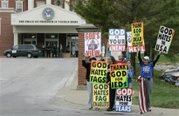 By MATT SEDENSKY, Associated Press Writer
The soldier's flag-draped casket is set on the gymnasium floor, below the unlit scoreboard, before bleachers crowded with mourners.
They are there for Sgt. Daniel Sesker, the young man known for an infectious laugh and a wide smile, his life taken abruptly by an improvised explosive device outside Tikrit. Inside his high school, those who loved him are just beginning to grieve.
Outside, near a cornfield awaiting planting, picketers thank God for Daniel Sesker's death, talk approvingly of his entrance into hell, and mock the mourners. Amid gusting winds, they struggle to hold up signs that read "Thank God for IEDs" and "God Hates Your Tears."
And back home in Kansas, tucked away in an office over Westboro Baptist Church, Pastor Fred Phelps need only think of what he's done, and he cracks a smile.
He has, for 15 years, directed a campaign unlike any other.
At curbsides, outside funerals and before state capitols, Phelps and his followers have branded this a nation of sinners, of people bound to live eternity in a fiery hell. They have called homosexuals the disgusting face of evil, and fallen American soldiers proof of God's wrath. And they've sneered at every other faith.
They are unapologetic in delivering their message and have no hope of convincing you, just as they say there is no hope for this doomed nation.
It's simply their duty, they believe, to let it be known that God hates you. That you're going to hell. That you're wrong and Fred's right.
___
Phelps and his followers began appearing outside funerals of American troops killed in Iraq since last June. They've already attended about 100 — offending communities and lawmakers so thoroughly that 31 state legislatures have debated bills to curb such protests, and Congress passed a law restricting demonstrations at national cemeteries. President Bush signed the bill on Memorial Day.
Westboro's protesters first gained widespread national attention in 1998. A 21-year-old University of Wyoming student, Matthew Shepard, had been lashed to a split-rail post, pistol-whipped, robbed, and left in near-freezing temperatures — all apparently because he was gay. Millions were horrified.
But not Phelps.
He and his followers showed up at the funeral with signs bearing their trademark message: "God Hates Fags." They chanted "Fags die, God laughs."
There have been thousands of protests since, at the funerals of homosexuals — but also at memorials for Mister Rogers, victims of Sept. 11 and West Virginia miners. There have been more than 25,000 such demonstrations, by the church's count.
No army of zealots is waging this campaign. Westboro Baptist has only about 75 members, nearly all of them Phelps' relatives.
Those who choose to stay in the Topeka, Kan., church must be willing not only to live an insular life, but to thrive on it. They must give at least 10 percent of their earnings to the church and spend thousands more traveling to spread its message.
Their belief in predestination — the idea that God determined at the time of one's creation whether they were bound for heaven or hell — is not unique. It stems from John Calvin's branch of the 16th century Protestant Reformation and is taught in mainstream churches.
Where Westboro parts ways, of course, is its emphasis on God's hatred and the way it spreads this message. Members believe they must alert the world's depraved sinners of their fate even though such people have no chance of going to heaven. They're not doing this to save you — they're doing it to save themselves.
The Westboro flock is out there all alone, both in their beliefs and in their methods. No other religious group has stepped forward to join them.
In the small sanctuary at Westboro Baptist — amid wood paneling, mauve carpeting and burnt-red cushions that recall a 1970s living room more than a house of worship — the congregation prays that all of God's chosen people will hear the call and make their way to this church. When the last person comes, they believe, Christ will return and the world will end.
The fluorescent lights shine on no crosses or paintings or statues, just a world map and a few signs. "Thank God for Maimed Soldiers," reads one.
Two hymns sung in perfect harmony serve as bookends for the service. The centerpiece is an impassioned sermon by the lanky, 76-year-old Phelps.
As he often does, he fixates on the media, and on lawmakers' attempts to silence him. He talks of God's hatred, and celebrates deadly events so many others mourn.
"We pray for more tornadoes, we pray for more hurricanes, that Katrina's just a tiny little preamble," he says near his closing. "That's what we pray for."
___
The path that brought Fred Phelps to this point is not a straight one.
He grew up a Methodist and enjoyed a childhood in which, he says, he was "happy as a duck."
Thetis Hudson, an 85-year-old Meridian, Miss., woman, lived across the street from Phelps' boyhood home. She remembers his mother playing sweet tunes at the piano and his father working as a railroad detective when it seemed no one else had a good job.
"They were good people. If you were going to pick a typical American family you would have picked them," Hudson said. "There was no hate."
Fred was 5 years old when his aunt came, sat him on a log and told him that his mother "had gone with the angels to be with God in heaven." He doesn't remember crying.
Phelps was bound for West Point when he attended a Methodist revival meeting and said he felt a calling to preach.
Phelps became a civil rights attorney, honored by minority groups for his dedication to cases of poor blacks. But he picketed the funeral of Coretta Scott King, and ultimately was disbarred from state courts for improprieties.
He ran as a Democrat for mayor, governor and senator who opened his law office to staffers on Al Gore's 1988 presidential bid. But he failed in each campaign and is uniformly derided by politicians on both sides of the aisle.
He raised 13 children, nine of whom defend him unwaveringly. Others tell of an abusive, unstable patriarch driven to fits of rage by nearly anything — from the way a child peeled an apple to forgetting to wipe one's shoes.
Family, for Fred Phelps, is second to his precepts.
Once Phelps was on the path to ministry, contact with his father — who he now calls a "wonderful, good old man" — began to wane. The elder Phelps had remarried a woman who was divorced, the sort of evil his son was beginning to preach against.
Others have been similarly marginalized: A sister, in-laws, children.
"These doctrines and things you believe have an inherent power and effect of sequestering you from all mankind on a close personal level," Phelps explained.
Shirley Phelps-Roper, a daughter of the pastor who frequently acts as a church spokeswoman, lost one of her sons to the outside world.
"Of course it's heartbreaking, on a level, for a short period of time," she said. "Because what you come to terms with is that the child is going to hell."
___
Fred Phelps' steps are cautious, his stare vacant, his speech slightly drawled. At a family picnic, when others line up for food, he stays behind. When songs are sung, he just looks on. He sits quiet most of the time, holding a 4-month-old great-granddaughter.
His demeanor shifts easily, quickly. He laughs, then looks sullen. Calls a granddaughter "love bug," then launches a brief tirade against Jews.
Many of Phelps' detractors admit he is brilliant. He has a habit of making it known by belittling those who question him. He makes it clear — there is no room for debate.
"That's one of the luxuries of being 100 percent right, absolutely 100 percent right," he said. "If you can read, you would agree with me."
Phelps' followers take that message to heart.
"They believe that what my dad says is law. He's the shepherd of the flock and he gets his inspiration from the Bible — he's the voice of God on earth," said the former Dortha Phelps, an estranged daughter who has taken the surname Bird to signify her freedom from the family.
Neither Phelps nor his congregants — who believe both he and they are prophets — claim to be without sin, but the pastor is infuriated when asked about their wrongdoings.
Children have had babies out of wedlock. Some have drifted from Westboro, which they believe to be the only true church on earth. The Bible's messages — as Phelps preaches them — have, at times, been ignored with this very family.
Why are some sins different? Why are followers forgiven for sins that would gain an outsider the label of hellbound whore?
Phelps rises from his chair and walks away.
___
It's an unseasonably cold day in Ogden, Iowa, outside the funeral of Daniel Sesker. Shirley Phelps-Roper has an American flag tucked in the waistband of her sweatpants, dragging it on the asphalt as she walks. Westboro's emissaries pose for snapshots like they're at a scenic lookout.
"I enjoy this," Phelps-Roper said. "This makes my day."
Her father is at home, in his office. The church library is nearby, and so is one of his favorite books — John Bunyan's "The Pilgrim's Progress."
Phelps compares himself to the allegory's main character, Christian, who arrives in a lush, elevated land known as the Delectable Mountains.
"The fruit on the trees was sweeter and it was so close to heaven that you could, every now and then, imagine that you see people in white clothing," Phelps said. "I've reached the Delectable Mountains."
He will die soon. His lifetime of preaching God's hate, he believes, has earned his place in heaven. And as his spirit ascends, protesters, no doubt, will assemble to celebrate his death.
Phelps has made it clear that he is overjoyed by the prospect. Bring a sign, he implores. Denounce me, defame me, he says. Dance on my grave, spit on my casket, laugh at my passing.
He knows the truth, he says. And in heaven, he'll just smile.
Copyright © 2006 The Associated Press.
Wednesday, May 31, 2006
A Collision Between Church and State is Bound to Happen Soon
Catholic Charities of Boston made the announcement on March 10: It was getting out of the adoption business. "We have encountered a dilemma we cannot resolve... The issue is adoption to same-sex couples."
It was shocking news. Catholic Charities of Boston, one of the nation's oldest adoption agencies, had long specialized in finding good homes for hard to place kids. "Catholic Charities was always at the top of the list," Paula Wisnewski, director of adoption for the Home for Little Wanderers, told the Boston Globe…
How did this tragedy happen?
It's a complicated story. Massachusetts law prohibited "orientation discrimination" over a decade ago. Then in November 2003, the Massachusetts Supreme Judicial Court ordered gay marriage. The majority ruled that only animus against gay people could explain why anyone would want to treat opposite-sex and same-sex couples differently. That same year, partly in response to growing pressure for gay marriage and adoption both here and in Europe, a Vatican statement made clear that placing children with same-sex couples violates Catholic teaching.
Then in October 2005, the Boston Globe broke the news: Boston Catholic Charities had placed a small number of children with same-sex couples. Sean Cardinal O'Malley, who has authority over Catholic Charities of Boston responded by stating the agency would no longer do so…
But getting square with the church didn't end Catholic Charities' woes. To operate in Massachusetts, an adoption agency must be licensed by the state. And to get a license, an agency must pledge to obey state laws barring discrimination — including the decade-old ban on orientation discrimination. With the legalization of gay marriage in the state, discrimination against same-sex couples would be outlawed, too.
Cardinal O'Malley asked Governor Mitt Romney for a religious exemption from the ban on orientation discrimination. Governor Romney reluctantly responded that he lacked legal authority to grant one unilaterally, by executive order. So the governor and archbishop turned to the state legislature, requesting a conscience exemption that would allow Catholic Charities to continue to help kids in a manner consistent with Catholic teaching.
To date, not a single other Massachusetts political leader appears willing to consider even the narrowest religious exemption…
From there, it was only a short step to the headline "State Putting Church Out of Adoption Business," which ran over an opinion piece in the Boston Globe by John Garvey, dean of Boston College Law School.
It's worth underscoring that Catholic Charities' problem with the state didn't hinge on its receipt of public money. Ron Madnick, president of the Massachusetts chapter of Americans United for Separation of Church and State, agreed with Garvey's assessment: "Even if Catholic Charities ceased receiving tax support and gave up its role as a state contractor, it still could not refuse to place children with same-sex couples."
This March, then, unexpectedly, a mere two years after the introduction of gay marriage in America, a number of latent concerns about the impact of this innovation on religious freedom ceased to be theoretical. How could Adam and Steve's marriage possibly hurt anyone else? When religious-right leaders prophesy negative consequences from gay marriage, they are often seen as overwrought. The First Amendment, we are told, will protect religious groups from persecution for their views about marriage.
So who is right? Is the fate of Catholic Charities of Boston an aberration or a sign of things to come?
I put the question to Anthony Picarello, president and general counsel of the Becket Fund for Religious Liberty… Just how serious are the coming conflicts over religious liberty stemming from gay marriage?
"The impact will be severe and pervasive," Picarello says flatly. "This is going to affect every aspect of church-state relations." Recent years, he predicts, will be looked back on as a time of relative peace between church and state, one where people had the luxury of litigating cases about things like the Ten Commandments in courthouses. In times of relative peace, says Picarello, people don't even notice that "the church is surrounded on all sides by the state; that church and state butt up against each other. The boundaries are usually peaceful, so it's easy sometimes to forget they are there. But because marriage affects just about every area of the law, gay marriage is going to create a point of conflict at every point around the perimeter…"
Picarello is a Harvard-trained litigator experienced in religious liberty issues. But predicting the legal consequences of as big a change as gay marriage is a job for more than one mind. So last December, the Becket Fund brought together ten religious liberty scholars of right and left to look at the question of the impact of gay marriage on the freedom of religion. Picarello summarizes: "All the scholars we got together see a problem; they all see a conflict coming. They differ on how it should be resolved and who should win, but they all see a conflict coming."
These are not necessarily scholars who oppose gay marriage… Marc Stern is the general counsel for the center-left American Jewish Congress… Jonathan Turley of George Washington law school has supported legalizing not only gay marriage but also polygamy.
Reading through these and the other scholars' papers, I noticed an odd feature. Generally speaking the scholars most opposed to gay marriage were somewhat less likely than others to foresee large conflicts ahead — perhaps because they tended to find it "inconceivable," as Doug Kmiec of Pepperdine law school put it, that "a successful analogy will be drawn in the public mind between irrational, and morally repugnant, racial discrimination and the rational, and at least morally debatable, differentiation of traditional and same-sex marriage."
That's a key consideration. For if orientation is like race, then people who oppose gay marriage will be treated under law like bigots who opposed interracial marriage. Sure, we don't arrest people for being racists, but the law does intervene in powerful ways to punish and discourage racial discrimination, not only by government but also by private entities. Doug Laycock, a religious liberty expert at the University of Texas law school, similarly told me we are a "long way" from equating orientation with race in the law…
The Litigator
As general counsel for the American Jewish Congress, Marc Stern knows religious liberty law from the inside out. Like Anthony Picarello, he sees the coming conflicts as pervasive. The problem is not that clergy will be forced to perform gay marriages or prevented from preaching their beliefs. Look past those big red herrings: "No one seriously believes that clergy will be forced, or even asked, to perform marriages that are anathema to them. Same-sex marriage would, however, work a sea change in American law. That change will reverberate across the legal and religious landscape in some ways that are today unpredictable," he writes in his Becket Fund paper.
Consider education. Same-sex marriage will affect religious educational institutions, he argues, in at least four ways: admissions, employment, housing, and regulation of clubs. One of Stern's big worries right now is a case in California where a private Christian high school expelled two girls who (the school says) announced they were in a lesbian relationship. Stern is not optimistic. And if the high school loses, he tells me, "then religious schools are out of business." Or at least the government will force religious schools to tolerate both conduct and proclamations by students they believe to be sinful.
Stern agrees… that public accommodation laws can and should force truly commercial enterprises to serve all comers. But, he asks, what of other places, such as religious camps, retreats, and homeless shelters? Will they be considered by courts to be places of public accommodation, too? Could a religious summer camp operated in strict conformity with religious principles refuse to accept children coming from same-sex marriages? What of a church-affiliated community center, with a gym and a Little League, that offers family programs? Must a religious-affiliated family services provider offer marriage counseling to same-sex couples designed to facilitate or preserve their relationships?
"Future conflict with the law in regard to licensing is certain with regard to psychological clinics, social workers, marital counselors, and the like," Stern wrote last December — well before the Boston Catholic Charities story broke.
Think about that for a moment. Of all the experts gathered to forecast the impact of gay marriage on religious organizations, no one, not even Stern, brought up adoption licenses. "Government is so pervasive, it's hard to know where the next battle will be," he tells me. "I thought I had a comprehensive catalog, but the adoption license issue didn't occur to me."
Will speech against gay marriage be allowed to continue unfettered? "Under the American regime of freedom of speech, the answer ought to be easy," according to Stern. But it is not entirely certain, he writes, "because sexual-harassment-in-the-workplace principles will likely migrate to suppress any expression of anti-same-sex-marriage views." Stern suggests how that might work.
In the corporate world, the expression of opposition to gay marriage will be suppressed not by gay ideologues but by corporate lawyers, who will draw the lines least likely to entangle the company in litigation. Stern likens this to "a paroxysm of prophylaxis — banning 'Jesus saves' because someone might take offense."
Or consider a recent case at William Paterson University, a state school in New Jersey. A senior faculty member sent out a mass email inviting people to attend movies with a gay theme. A student employee, a 63-year-old Muslim named Jihad Daniel, replied to the professor in a private email asking not to receive messages "about 'Connie and Sally' and 'Adam and Steve.'" He went on, "These are perversions. The absence of God in higher education brings on confusion. That is why in these classes the Creator of the heavens and the earth is never mentioned." The result: Daniel received a letter of reprimand for using the "derogatory and demeaning" word "perversions" in violation of state discrimination and harassment regulations.
Interestingly, Stern points out, a single "derogatory or demeaning" remark not seeking sexual gratification or threatening a person's job security does not constitute harassment under ordinary federal and state sexual harassment law originally intended to protect women in the workplace. Moreover, Stern says, "our entire free speech regime depends on the principle that no adult has a right to expect the law will protect him from being exposed to disagreeable speech."
Except, apparently in New Jersey, where a state attorney general's opinion concluded, "[C]learly speech which violates a nondiscrimination policy is not protected." "This was so 'clear' to the writer," notes Stern, "that she cited not a single case or law review article in support." Ultimately, the school withdrew its reprimand from Daniel's employment file after receiving negative publicity and the threat of a lawsuit from the Foundation for Individual Rights in Education (FIRE).
Sexual harassment law as an instrument for suppressing religious speech? A few days after I interviewed Stern, an Alliance Defense Fund press release dropped into my mail box: "OSU Librarian Slapped with 'Sexual Harassment' Charge for Recommending Conservative Books for Freshmen." One of the books the Ohio State librarian (a pacifist Quaker who drives a horse and buggy to work) recommended was It Takes a Family by Senator Rick Santorum. Three professors alleged that the mere appearance of such a book on a freshman reading list made them feel "unsafe." The faculty voted to pursue the sexual harassment allegation, and the process quickly resulted in the charge being dropped.
In the end the investigation of the librarian was more of a nuisance — you might call it harassment — than anything else. But the imbalance in terms of free speech remains clear: People who favor gay rights face no penalty for speaking their views, but can inflict a risk of litigation, investigation, and formal and informal career penalties on others whose views they dislike. Meanwhile, people who think gay marriage is wrong cannot know for sure where the line is now or where it will be redrawn in the near future. "Soft" coercion produces no martyrs to disturb anyone's conscience, yet it is highly effective in chilling the speech of ordinary people.
Finally, I ask Stern the big question on everyone's mind. Religious groups that take government funding will almost certainly be required to play by the nondiscrimination rules, but what about groups that, while receiving no government grants, are tax-exempt? Can a group — a church or religious charity, say — that opposes gay marriage keep its tax exemption if gay marriage becomes the law? "That," says Stern, "is the 18 trillion dollar question."
Twenty years ago it would have been inconceivable that a Christian or Jewish organization that opposed gay marriage might be treated as racist in the public square. Today? It's just not clear.
"In Massachusetts I'd be very worried," Stern says finally. The churches themselves might have a First Amendment defense if a state government or state courts tried to withdraw their exemption, he says, but "the parachurch institutions are very much at risk and may be put out of business because of the licensing issues, or for these other reasons — it's very unclear. None of us nonprofits can function without [state] tax exemption. As a practical matter, any large charity needs that real estate tax exemption."
He blames religious conservatives for adopting the wrong political strategy on gay issues. "Live and let live," he tells me, is the only thing around the world that works. But I ask him point blank what he would say to people who dismiss the threat to free exercise of religion as evangelical hysteria. "It's not hysteria, this is very real," he tells me, "Boston Catholic Charities shows that."
Fundamentally, Stern sees this as a "religious war" between people for whom an egalitarian secular ethic is the only rational option and people who can make room for an ethic based on faith in a God who commands. There are very few signs of a willingness to compromise on either side, he notes.
"You look around the world and even the right to preach is in doubt," he tells me. "In the United States we are not foreseeably in that position. Fundamentally speech is still safe in the United States. Beyond speech, nothing is safe…"
The Legal Eagle
Jonathan Turley, the George Washington professor who is a First Amendment specialist, also sees a serious risk ahead. Turley has no problem with gay marriage. But the gay marriage debate, he notes, exposes "long ignored weaknesses in doctrines relating to free speech, free exercise, and the right to association."
Before 1970 the law was "viewpoint neutral" with regard to the tax exempt status of all charitable, religious, and public interest organizations under section 501(c)(3), he says. The tax exemption was viewed not as a public subsidy, but as a means of encouraging private donations and charitable conduct in general. In 1971, the IRS issued a decision redefining the tax exemption as a public endorsement or subsidy. This meant that the IRS would strip an organization of its exempt status if its purposes, although legal, were "contrary to public policy." The goal at the time was to use legal pressure to end private racial discrimination. But why stop there?
Right now, Turley notes, there is no clear federal public policy against discrimination on the basis of sexual orientation. But such a policy is imminent, he believes, most likely within the decade…
It's not that hard to imagine: Pass an antidiscrimination law at the federal level, which polls suggest the majority of Americans already support; look for a 5-or 10-point swing in public opinion on gay marriage; then add a new IRS commissioner (not directly accountable to the voters) who wants to make his or her progressive mark, and religious groups would wake up to find themselves playing in a whole new ballgame.
Religious bodies may be as simple as the small, independent congregations that exist all over America, but often they are large and complex institutions with extensive property and multiple missions, notably saving souls. Even a slight risk of anything so damaging as the loss of tax-exempt status will persuade many such groups to at least mute their marriage theology in the interest of preserving the rest of their activities. Such a self-imposed muting on the part of faith communities would change our culture of marriage, and our understanding of the free exercise of religion, without necessarily creating visible martyrs.
The Marriage Line
How much of the coming threat to religious liberty actually stems from same-sex marriage? These experts' comments make clear that it is not only gay marriage, but also the set of ideas that leads to gay marriage — the insistence on one specific vision of gay rights — that has placed church and state on a collision course. Once sexual orientation is conceptualized as a protected status on a par with race, traditional religions that condemn homosexual conduct will face increasing legal pressures regardless of what courts and Congress do about marriage itself.
Nevertheless, marriage is a particularly potent legal "bright line." Support for marriage is firmly established in our legal tradition and in our public policy. After it became apparent that no religious exemption would be available for Catholic Charities in Massachusetts, the church looked hard for legal avenues to continue helping kids without violating Catholic principles. If the stumbling block had been Catholic Charities' unwillingness to place children with single people — or with gay singles — marriage might have provided a legal "safe harbor": Catholic Charities might have been able to specialize in placing children with married couples and thus avoid collision with state laws banning orientation discrimination. After Goodridge, however, "marriage" includes gay marriage, so no such haven would have been available in Massachusetts.
Precisely because support for marriage is public policy, once marriage includes gay couples, groups who oppose gay marriage are likely to be judged in violation of public policy, triggering a host of negative consequences, including the loss of tax-exempt status. Because marriage is not a private act, but a protected public status, the legalization of gay marriage sends a strong signal that orientation is now on a par with race in the nondiscrimination game. And when we get gay marriage because courts have declared it a constitutional right, the signal is stronger still…
On the cultural level, the declaration by a court that only animus explains why anyone would treat two men differently from a husband and wife represents an unfolding civil rights logic that has real consequences. As Boston Globe columnist Ellen Goodman put it, "But if you give one church permission to discriminate against gays, what's next? Permission to discriminate against blacks or Jews who want to adopt?"
End Game
On April 15, the Boston Globe ran a story about three other Catholic adoption agencies, in Worcester, Fall River, and Springfield, that do not do gay adoptions. The story noted that, for now, these agencies will not be punished for their refusal. Constantia Papanikolaou, general counsel for the state Department of Early Education and Care, said her agency is holding off taking any action because the governor has proposed legislation that would provide a religious exemption for adoption agencies. "We're going to wait and see how the legislation plays out," Papanikolaou said.
The reprieve is likely to be short-lived. Observers universally say the religious exemption has no chance of passage, and in a few months, Mitt Romney will no longer be governor. What then? The Boston Globe story provides a clue: "Gary Buseck, legal director of the Gay & Lesbian Advocates & Defenders in Boston, said his group realizes that Massachusetts will have a new governor next year, and it expects that he or she will aggressively enforce the state's antidiscrimination laws."
Marc Stern is looking more and more like a reluctant prophet: "It's going to be a train wreck," he told me in the offices of the American Jewish Congress high above Manhattan. "A very dangerous train wreck. I don't see anyone trying to stem the train wreck, or slow down the trains. Both sides are really looking for Armageddon, and they frankly both want to win. I prefer to avoid Armageddon, if possible."
It was shocking news. Catholic Charities of Boston, one of the nation's oldest adoption agencies, had long specialized in finding good homes for hard to place kids. "Catholic Charities was always at the top of the list," Paula Wisnewski, director of adoption for the Home for Little Wanderers, told the Boston Globe…
How did this tragedy happen?
It's a complicated story. Massachusetts law prohibited "orientation discrimination" over a decade ago. Then in November 2003, the Massachusetts Supreme Judicial Court ordered gay marriage. The majority ruled that only animus against gay people could explain why anyone would want to treat opposite-sex and same-sex couples differently. That same year, partly in response to growing pressure for gay marriage and adoption both here and in Europe, a Vatican statement made clear that placing children with same-sex couples violates Catholic teaching.
Then in October 2005, the Boston Globe broke the news: Boston Catholic Charities had placed a small number of children with same-sex couples. Sean Cardinal O'Malley, who has authority over Catholic Charities of Boston responded by stating the agency would no longer do so…
But getting square with the church didn't end Catholic Charities' woes. To operate in Massachusetts, an adoption agency must be licensed by the state. And to get a license, an agency must pledge to obey state laws barring discrimination — including the decade-old ban on orientation discrimination. With the legalization of gay marriage in the state, discrimination against same-sex couples would be outlawed, too.
Cardinal O'Malley asked Governor Mitt Romney for a religious exemption from the ban on orientation discrimination. Governor Romney reluctantly responded that he lacked legal authority to grant one unilaterally, by executive order. So the governor and archbishop turned to the state legislature, requesting a conscience exemption that would allow Catholic Charities to continue to help kids in a manner consistent with Catholic teaching.
To date, not a single other Massachusetts political leader appears willing to consider even the narrowest religious exemption…
From there, it was only a short step to the headline "State Putting Church Out of Adoption Business," which ran over an opinion piece in the Boston Globe by John Garvey, dean of Boston College Law School.
It's worth underscoring that Catholic Charities' problem with the state didn't hinge on its receipt of public money. Ron Madnick, president of the Massachusetts chapter of Americans United for Separation of Church and State, agreed with Garvey's assessment: "Even if Catholic Charities ceased receiving tax support and gave up its role as a state contractor, it still could not refuse to place children with same-sex couples."
This March, then, unexpectedly, a mere two years after the introduction of gay marriage in America, a number of latent concerns about the impact of this innovation on religious freedom ceased to be theoretical. How could Adam and Steve's marriage possibly hurt anyone else? When religious-right leaders prophesy negative consequences from gay marriage, they are often seen as overwrought. The First Amendment, we are told, will protect religious groups from persecution for their views about marriage.
So who is right? Is the fate of Catholic Charities of Boston an aberration or a sign of things to come?
I put the question to Anthony Picarello, president and general counsel of the Becket Fund for Religious Liberty… Just how serious are the coming conflicts over religious liberty stemming from gay marriage?
"The impact will be severe and pervasive," Picarello says flatly. "This is going to affect every aspect of church-state relations." Recent years, he predicts, will be looked back on as a time of relative peace between church and state, one where people had the luxury of litigating cases about things like the Ten Commandments in courthouses. In times of relative peace, says Picarello, people don't even notice that "the church is surrounded on all sides by the state; that church and state butt up against each other. The boundaries are usually peaceful, so it's easy sometimes to forget they are there. But because marriage affects just about every area of the law, gay marriage is going to create a point of conflict at every point around the perimeter…"
Picarello is a Harvard-trained litigator experienced in religious liberty issues. But predicting the legal consequences of as big a change as gay marriage is a job for more than one mind. So last December, the Becket Fund brought together ten religious liberty scholars of right and left to look at the question of the impact of gay marriage on the freedom of religion. Picarello summarizes: "All the scholars we got together see a problem; they all see a conflict coming. They differ on how it should be resolved and who should win, but they all see a conflict coming."
These are not necessarily scholars who oppose gay marriage… Marc Stern is the general counsel for the center-left American Jewish Congress… Jonathan Turley of George Washington law school has supported legalizing not only gay marriage but also polygamy.
Reading through these and the other scholars' papers, I noticed an odd feature. Generally speaking the scholars most opposed to gay marriage were somewhat less likely than others to foresee large conflicts ahead — perhaps because they tended to find it "inconceivable," as Doug Kmiec of Pepperdine law school put it, that "a successful analogy will be drawn in the public mind between irrational, and morally repugnant, racial discrimination and the rational, and at least morally debatable, differentiation of traditional and same-sex marriage."
That's a key consideration. For if orientation is like race, then people who oppose gay marriage will be treated under law like bigots who opposed interracial marriage. Sure, we don't arrest people for being racists, but the law does intervene in powerful ways to punish and discourage racial discrimination, not only by government but also by private entities. Doug Laycock, a religious liberty expert at the University of Texas law school, similarly told me we are a "long way" from equating orientation with race in the law…
The Litigator
As general counsel for the American Jewish Congress, Marc Stern knows religious liberty law from the inside out. Like Anthony Picarello, he sees the coming conflicts as pervasive. The problem is not that clergy will be forced to perform gay marriages or prevented from preaching their beliefs. Look past those big red herrings: "No one seriously believes that clergy will be forced, or even asked, to perform marriages that are anathema to them. Same-sex marriage would, however, work a sea change in American law. That change will reverberate across the legal and religious landscape in some ways that are today unpredictable," he writes in his Becket Fund paper.
Consider education. Same-sex marriage will affect religious educational institutions, he argues, in at least four ways: admissions, employment, housing, and regulation of clubs. One of Stern's big worries right now is a case in California where a private Christian high school expelled two girls who (the school says) announced they were in a lesbian relationship. Stern is not optimistic. And if the high school loses, he tells me, "then religious schools are out of business." Or at least the government will force religious schools to tolerate both conduct and proclamations by students they believe to be sinful.
Stern agrees… that public accommodation laws can and should force truly commercial enterprises to serve all comers. But, he asks, what of other places, such as religious camps, retreats, and homeless shelters? Will they be considered by courts to be places of public accommodation, too? Could a religious summer camp operated in strict conformity with religious principles refuse to accept children coming from same-sex marriages? What of a church-affiliated community center, with a gym and a Little League, that offers family programs? Must a religious-affiliated family services provider offer marriage counseling to same-sex couples designed to facilitate or preserve their relationships?
"Future conflict with the law in regard to licensing is certain with regard to psychological clinics, social workers, marital counselors, and the like," Stern wrote last December — well before the Boston Catholic Charities story broke.
Think about that for a moment. Of all the experts gathered to forecast the impact of gay marriage on religious organizations, no one, not even Stern, brought up adoption licenses. "Government is so pervasive, it's hard to know where the next battle will be," he tells me. "I thought I had a comprehensive catalog, but the adoption license issue didn't occur to me."
Will speech against gay marriage be allowed to continue unfettered? "Under the American regime of freedom of speech, the answer ought to be easy," according to Stern. But it is not entirely certain, he writes, "because sexual-harassment-in-the-workplace principles will likely migrate to suppress any expression of anti-same-sex-marriage views." Stern suggests how that might work.
In the corporate world, the expression of opposition to gay marriage will be suppressed not by gay ideologues but by corporate lawyers, who will draw the lines least likely to entangle the company in litigation. Stern likens this to "a paroxysm of prophylaxis — banning 'Jesus saves' because someone might take offense."
Or consider a recent case at William Paterson University, a state school in New Jersey. A senior faculty member sent out a mass email inviting people to attend movies with a gay theme. A student employee, a 63-year-old Muslim named Jihad Daniel, replied to the professor in a private email asking not to receive messages "about 'Connie and Sally' and 'Adam and Steve.'" He went on, "These are perversions. The absence of God in higher education brings on confusion. That is why in these classes the Creator of the heavens and the earth is never mentioned." The result: Daniel received a letter of reprimand for using the "derogatory and demeaning" word "perversions" in violation of state discrimination and harassment regulations.
Interestingly, Stern points out, a single "derogatory or demeaning" remark not seeking sexual gratification or threatening a person's job security does not constitute harassment under ordinary federal and state sexual harassment law originally intended to protect women in the workplace. Moreover, Stern says, "our entire free speech regime depends on the principle that no adult has a right to expect the law will protect him from being exposed to disagreeable speech."
Except, apparently in New Jersey, where a state attorney general's opinion concluded, "[C]learly speech which violates a nondiscrimination policy is not protected." "This was so 'clear' to the writer," notes Stern, "that she cited not a single case or law review article in support." Ultimately, the school withdrew its reprimand from Daniel's employment file after receiving negative publicity and the threat of a lawsuit from the Foundation for Individual Rights in Education (FIRE).
Sexual harassment law as an instrument for suppressing religious speech? A few days after I interviewed Stern, an Alliance Defense Fund press release dropped into my mail box: "OSU Librarian Slapped with 'Sexual Harassment' Charge for Recommending Conservative Books for Freshmen." One of the books the Ohio State librarian (a pacifist Quaker who drives a horse and buggy to work) recommended was It Takes a Family by Senator Rick Santorum. Three professors alleged that the mere appearance of such a book on a freshman reading list made them feel "unsafe." The faculty voted to pursue the sexual harassment allegation, and the process quickly resulted in the charge being dropped.
In the end the investigation of the librarian was more of a nuisance — you might call it harassment — than anything else. But the imbalance in terms of free speech remains clear: People who favor gay rights face no penalty for speaking their views, but can inflict a risk of litigation, investigation, and formal and informal career penalties on others whose views they dislike. Meanwhile, people who think gay marriage is wrong cannot know for sure where the line is now or where it will be redrawn in the near future. "Soft" coercion produces no martyrs to disturb anyone's conscience, yet it is highly effective in chilling the speech of ordinary people.
Finally, I ask Stern the big question on everyone's mind. Religious groups that take government funding will almost certainly be required to play by the nondiscrimination rules, but what about groups that, while receiving no government grants, are tax-exempt? Can a group — a church or religious charity, say — that opposes gay marriage keep its tax exemption if gay marriage becomes the law? "That," says Stern, "is the 18 trillion dollar question."
Twenty years ago it would have been inconceivable that a Christian or Jewish organization that opposed gay marriage might be treated as racist in the public square. Today? It's just not clear.
"In Massachusetts I'd be very worried," Stern says finally. The churches themselves might have a First Amendment defense if a state government or state courts tried to withdraw their exemption, he says, but "the parachurch institutions are very much at risk and may be put out of business because of the licensing issues, or for these other reasons — it's very unclear. None of us nonprofits can function without [state] tax exemption. As a practical matter, any large charity needs that real estate tax exemption."
He blames religious conservatives for adopting the wrong political strategy on gay issues. "Live and let live," he tells me, is the only thing around the world that works. But I ask him point blank what he would say to people who dismiss the threat to free exercise of religion as evangelical hysteria. "It's not hysteria, this is very real," he tells me, "Boston Catholic Charities shows that."
Fundamentally, Stern sees this as a "religious war" between people for whom an egalitarian secular ethic is the only rational option and people who can make room for an ethic based on faith in a God who commands. There are very few signs of a willingness to compromise on either side, he notes.
"You look around the world and even the right to preach is in doubt," he tells me. "In the United States we are not foreseeably in that position. Fundamentally speech is still safe in the United States. Beyond speech, nothing is safe…"
The Legal Eagle
Jonathan Turley, the George Washington professor who is a First Amendment specialist, also sees a serious risk ahead. Turley has no problem with gay marriage. But the gay marriage debate, he notes, exposes "long ignored weaknesses in doctrines relating to free speech, free exercise, and the right to association."
Before 1970 the law was "viewpoint neutral" with regard to the tax exempt status of all charitable, religious, and public interest organizations under section 501(c)(3), he says. The tax exemption was viewed not as a public subsidy, but as a means of encouraging private donations and charitable conduct in general. In 1971, the IRS issued a decision redefining the tax exemption as a public endorsement or subsidy. This meant that the IRS would strip an organization of its exempt status if its purposes, although legal, were "contrary to public policy." The goal at the time was to use legal pressure to end private racial discrimination. But why stop there?
Right now, Turley notes, there is no clear federal public policy against discrimination on the basis of sexual orientation. But such a policy is imminent, he believes, most likely within the decade…
It's not that hard to imagine: Pass an antidiscrimination law at the federal level, which polls suggest the majority of Americans already support; look for a 5-or 10-point swing in public opinion on gay marriage; then add a new IRS commissioner (not directly accountable to the voters) who wants to make his or her progressive mark, and religious groups would wake up to find themselves playing in a whole new ballgame.
Religious bodies may be as simple as the small, independent congregations that exist all over America, but often they are large and complex institutions with extensive property and multiple missions, notably saving souls. Even a slight risk of anything so damaging as the loss of tax-exempt status will persuade many such groups to at least mute their marriage theology in the interest of preserving the rest of their activities. Such a self-imposed muting on the part of faith communities would change our culture of marriage, and our understanding of the free exercise of religion, without necessarily creating visible martyrs.
The Marriage Line
How much of the coming threat to religious liberty actually stems from same-sex marriage? These experts' comments make clear that it is not only gay marriage, but also the set of ideas that leads to gay marriage — the insistence on one specific vision of gay rights — that has placed church and state on a collision course. Once sexual orientation is conceptualized as a protected status on a par with race, traditional religions that condemn homosexual conduct will face increasing legal pressures regardless of what courts and Congress do about marriage itself.
Nevertheless, marriage is a particularly potent legal "bright line." Support for marriage is firmly established in our legal tradition and in our public policy. After it became apparent that no religious exemption would be available for Catholic Charities in Massachusetts, the church looked hard for legal avenues to continue helping kids without violating Catholic principles. If the stumbling block had been Catholic Charities' unwillingness to place children with single people — or with gay singles — marriage might have provided a legal "safe harbor": Catholic Charities might have been able to specialize in placing children with married couples and thus avoid collision with state laws banning orientation discrimination. After Goodridge, however, "marriage" includes gay marriage, so no such haven would have been available in Massachusetts.
Precisely because support for marriage is public policy, once marriage includes gay couples, groups who oppose gay marriage are likely to be judged in violation of public policy, triggering a host of negative consequences, including the loss of tax-exempt status. Because marriage is not a private act, but a protected public status, the legalization of gay marriage sends a strong signal that orientation is now on a par with race in the nondiscrimination game. And when we get gay marriage because courts have declared it a constitutional right, the signal is stronger still…
On the cultural level, the declaration by a court that only animus explains why anyone would treat two men differently from a husband and wife represents an unfolding civil rights logic that has real consequences. As Boston Globe columnist Ellen Goodman put it, "But if you give one church permission to discriminate against gays, what's next? Permission to discriminate against blacks or Jews who want to adopt?"
End Game
On April 15, the Boston Globe ran a story about three other Catholic adoption agencies, in Worcester, Fall River, and Springfield, that do not do gay adoptions. The story noted that, for now, these agencies will not be punished for their refusal. Constantia Papanikolaou, general counsel for the state Department of Early Education and Care, said her agency is holding off taking any action because the governor has proposed legislation that would provide a religious exemption for adoption agencies. "We're going to wait and see how the legislation plays out," Papanikolaou said.
The reprieve is likely to be short-lived. Observers universally say the religious exemption has no chance of passage, and in a few months, Mitt Romney will no longer be governor. What then? The Boston Globe story provides a clue: "Gary Buseck, legal director of the Gay & Lesbian Advocates & Defenders in Boston, said his group realizes that Massachusetts will have a new governor next year, and it expects that he or she will aggressively enforce the state's antidiscrimination laws."
Marc Stern is looking more and more like a reluctant prophet: "It's going to be a train wreck," he told me in the offices of the American Jewish Congress high above Manhattan. "A very dangerous train wreck. I don't see anyone trying to stem the train wreck, or slow down the trains. Both sides are really looking for Armageddon, and they frankly both want to win. I prefer to avoid Armageddon, if possible."
Sometimes Even Gay People Can Be Bigots
Liberals are among the most bigotted people I know ...
GAY MARRIAGE CREATES NEW CONFLICTS FOR NEIGHBORS
By Maggie Gallagher
The story circulating on the Internet was hard to believe at first: A North Truro, Mass., volunteer fireman lost his position because he signed a petition opposing gay marriage?
I was lucky enough to get Leo "Skip" Childs on the phone. Skip is the kind of guy who makes you ashamed of yourself, but very proud to be an American. He volunteers many hours in the tiny town of North Truro, repairing fire trucks, saving lives. "Last month I went on 22 rescue calls, plus 10 to 15 hours of administrative duties," he told me.
Why? "Because I think everyone that lives in a small community has got to pitch in," he says. "I'd love to go work on the finance committee, but I don't know much about that. I can help you when your fire truck is broken, and I can help you in the back of the ambulance. That's what I try to do."
His wife, Marjorie, also helps. "Her cooking is famous in three towns. A piece of cake and warm cup of coffee," he says proudly, "that's what my wife does to support the rescue squad."
After five years, Skip thought his reappointment to the Board of Fire Engineers would be routine. Then Selectman Paul Asher-Best spoke up: "Recent action you took, Mr. Childs, indicates to me that you think that gay people are less than fully human, and not entitled to all the civil rights that are afforded to them. The Supreme Judicial Court talks about marriage rights being a basic civil right. ... I need ... assurance from you that you would offer equal protection to everyone in Truro, including households headed by gay or lesbian people, because to me your action speaks otherwise."
Skip is scratching his head at this point. How could signing a marriage petition make you unfit to rescue people? He tried to be conciliatory: "I'm more concerned that a special interest group with a strong lobby would be able to influence a judge in our state. ... I wouldn't have a problem with it if it passed on the referendum."
But with that comment, Paul Asher-Best went ballistic. As Asher-Best later told me, "I consider myself one half of a loving couple who has been together 27 years. I don't consider myself a special interest.
"Mr. Childs' explanation, just like I said, amplifies his bias," he pronounced, "and I think for that reason I couldn't support him."
The town council voted for a new Board of Fire Engineers, minus Skip Childs. The Childses were humiliated. After nearly a decade of volunteering every spare hour to rescue your neighbors, this is your reward? Dressed down as a bigot in public for signing a marriage petition?
Paul Asher-Best is certainly not repentant. "To me, it reminds me of when back in the bad old days when a black man even looking a white man in the eye was an offense. I feel like this 'uppity f------' had the nerve to look a straight guy in the eye and ask him to explain himself. If the issue is interracial marriage, would questioning him on attitudes toward black people be so out of line?"
Paul Asher-Best is no villain. He's a good man with a bad idea: People who disagree with him on gay marriage demonstrate irrational hatred toward gay people. After all, that is what the Massachusetts high court actually ruled.
Skip is hopeful that when a new position opens up in June, he will be allowed again to serve. I hope so too.
But two ideas are clearly now on a collision course in America: 1) There's something special about unions of husbands and wives, and 2) there's no difference between same-sex and opposite-sex couples, and only hate-filled bigots think otherwise. In Massachusetts, the second idea is now the official view of the law.
Skip Childs is one of the first casualties of this new conflict. But as our senators debate a Marriage Protection Amendment June 5, they should be forewarned: If they leave marriage to the courts, he won't be the last.
(Readers may reach Maggie Gallagher at MaggieBox2006@yahoo.com.)
Copyright © 2006 Yahoo! Inc.
GAY MARRIAGE CREATES NEW CONFLICTS FOR NEIGHBORS
By Maggie Gallagher
The story circulating on the Internet was hard to believe at first: A North Truro, Mass., volunteer fireman lost his position because he signed a petition opposing gay marriage?
I was lucky enough to get Leo "Skip" Childs on the phone. Skip is the kind of guy who makes you ashamed of yourself, but very proud to be an American. He volunteers many hours in the tiny town of North Truro, repairing fire trucks, saving lives. "Last month I went on 22 rescue calls, plus 10 to 15 hours of administrative duties," he told me.
Why? "Because I think everyone that lives in a small community has got to pitch in," he says. "I'd love to go work on the finance committee, but I don't know much about that. I can help you when your fire truck is broken, and I can help you in the back of the ambulance. That's what I try to do."
His wife, Marjorie, also helps. "Her cooking is famous in three towns. A piece of cake and warm cup of coffee," he says proudly, "that's what my wife does to support the rescue squad."
After five years, Skip thought his reappointment to the Board of Fire Engineers would be routine. Then Selectman Paul Asher-Best spoke up: "Recent action you took, Mr. Childs, indicates to me that you think that gay people are less than fully human, and not entitled to all the civil rights that are afforded to them. The Supreme Judicial Court talks about marriage rights being a basic civil right. ... I need ... assurance from you that you would offer equal protection to everyone in Truro, including households headed by gay or lesbian people, because to me your action speaks otherwise."
Skip is scratching his head at this point. How could signing a marriage petition make you unfit to rescue people? He tried to be conciliatory: "I'm more concerned that a special interest group with a strong lobby would be able to influence a judge in our state. ... I wouldn't have a problem with it if it passed on the referendum."
But with that comment, Paul Asher-Best went ballistic. As Asher-Best later told me, "I consider myself one half of a loving couple who has been together 27 years. I don't consider myself a special interest.
"Mr. Childs' explanation, just like I said, amplifies his bias," he pronounced, "and I think for that reason I couldn't support him."
The town council voted for a new Board of Fire Engineers, minus Skip Childs. The Childses were humiliated. After nearly a decade of volunteering every spare hour to rescue your neighbors, this is your reward? Dressed down as a bigot in public for signing a marriage petition?
Paul Asher-Best is certainly not repentant. "To me, it reminds me of when back in the bad old days when a black man even looking a white man in the eye was an offense. I feel like this 'uppity f------' had the nerve to look a straight guy in the eye and ask him to explain himself. If the issue is interracial marriage, would questioning him on attitudes toward black people be so out of line?"
Paul Asher-Best is no villain. He's a good man with a bad idea: People who disagree with him on gay marriage demonstrate irrational hatred toward gay people. After all, that is what the Massachusetts high court actually ruled.
Skip is hopeful that when a new position opens up in June, he will be allowed again to serve. I hope so too.
But two ideas are clearly now on a collision course in America: 1) There's something special about unions of husbands and wives, and 2) there's no difference between same-sex and opposite-sex couples, and only hate-filled bigots think otherwise. In Massachusetts, the second idea is now the official view of the law.
Skip Childs is one of the first casualties of this new conflict. But as our senators debate a Marriage Protection Amendment June 5, they should be forewarned: If they leave marriage to the courts, he won't be the last.
(Readers may reach Maggie Gallagher at MaggieBox2006@yahoo.com.)
Copyright © 2006 Yahoo! Inc.
Sunday, May 28, 2006
Horror of Horrors; Still More Grief for the Folks in Indonesia
 After a devasting tsunami, now a major earthquake; what more are those poor folks in the south Pacific country of Indonesia going to have to endure? The hell seems to go on and on for them ... read this latest and weep.
Indonesians plead for aid; toll over 4,300
By CHRIS BRUMMITT, Associated Press Writer
Tens of thousands camped out for a second night Sunday in streets, cassava fields and the paths between rice paddies as the death toll from Indonesia's earthquake topped 4,300.
Rattled by hundreds of aftershocks, exhausted and grieving survivors scavenged for food and clothes in the brick, wood and tile rubble of their flattened houses. They pleaded for aid, which — despite worldwide pledges of millions of dollars and planes carrying medicine and food — seemed to be coming too slow.
Torrential rain late Sunday added to the misery of some 200,000 people left homeless by Saturday's 6.3-magnitude quake, most of them living in makeshift shelters of plastic, canvas or cardboard. Thousands of wounded awaited treatment in hospitals overflowing with bloodied patients.
"So far no one from the government has shown any care for us," said villager Brojo Sukardi. "Please tell people to help us."
The quake on the island of Java was the fourth destructive temblor to hit Indonesia in the last 17 months, including the one that spawned the Dec. 26, 2004, tsunami that killed 230,000 people across Asia, most of them on this Indian Ocean archipelago.
The country also is coping with the bird flu crisis, Islamic militant terror attacks, and the threat of eruption from Mount Merapi. The quake not only raised activity at the rumbling volcano but also damaged the 9th-century Prambanan temple, a U.N. world heritage site.
The disaster zone covered hundreds of square miles of mostly farming communities to the south of the ancient city of Yogyakarta. Power and telephone service was out Sunday across much of the region. As many as 450 aftershocks followed, the strongest a magnitude 5.2.
The worst devastation was in the Bantul district, which accounted for three-quarters of the deaths. One man dug his 5-year-old daughter out of the rubble of her bedroom only to have her die in a hospital awaiting treatment with hundreds of others.
"Her last words were 'Daddy, Daddy,'" said Poniran, who like many Indonesians uses only one name.
"I have to start my life from zero again."
In Peni, a hamlet on Bantul's southern outskirts, 20 residents searched for a neighbor after finding the bodies of his wife and three children. Villagers set up simple clinics despite shortages in medicine and equipment. Women cooked catfish from a nearby pond for dozens of people huddled under a large tent.
The U.N. World Food Program started distributing emergency food rations Sunday, with three trucks bringing high-energy biscuits to some of the worst-hit districts and two Singapore military cargo planes landing with doctors and medical supplies.
"I regret the slow distribution of aid," Idam Samawi, the Bantul district chief, told The Associated Press.
"Many government officials have no sensitivity to this. They work slowly under complicated bureaucracy, while survivors are racing against death and disease."
At least 4,332 people were killed, according to government figures, and the International Federation of Red Cross and Red Crescent said at least 200,000 people were left homeless. Most of the dead were buried within hours of the disaster, in line with Islamic tradition.
The earthquake hit at 5:54 a.m. as most people slept, caving in tile roofs and sending walls crashing down. Survivors screamed as they ran from their homes, some clutching bloodied children and the elderly.
The quake's epicenter was 50 miles south of the volcano, and activity increased soon after the temblor. A large burst spewed hot clouds and sent debris cascading some two miles down its western flank. No one was injured because nearby residents had been evacuated.
Officials said the famed 7th-century Borobudur Buddhist temple, one of Indonesia's famed tourist attractions, was not affected. But Prambanan, a spectacular Hindu temple to the southeast, suffered serious damage, with hundreds of stone carvings and blocks scattered around the ancient site.
It will be closed until archeologists can determine whether the foundation was damaged, Agus Waluyo, head of the Yogyakarta Archaeological Conservation Agency, said Sunday. Close to 1 million tourists visit the Borobudur and Prambanan temples every year.
International agencies and nations across Europe and Asia pledged millions of dollars in aid and prepared shipments of tents, blankets, generators, water purification equipment and other supplies. The United States promised $2.5 million in emergency aid; the European Union granted $3.8 million. Indonesia said late Sunday it would allocate $107 million to help rebuild over the next year.
Indonesia, the world's largest island chain, is prone to seismic upheaval due to its location on the so-called "Ring of Fire," an arc of volcanos and fault lines encircling the Pacific Basin. It has 76 volcanos, the largest number in the world.
Copyright © 2006 The Associated Press.
Saturday, May 27, 2006
Bush Braces For Marine Scandal
[Editor's Note: Finally, it appears that Bush and other big shots in Washington are going to pay attention to the 'MaiLai scandal' of the Iraqi War. Old people like myself will recall when the MaiLai thing during the Viet Nam War of the 1970's helped to shake things up quite a lot. MaiLai was a village in VietNam which the military blew to bits during Vietnam. The Marines did the same thing several months ago to a small town in Iraq.
If you missed the report when it was first on the wires or discussed here in this blog, you can read it again here. So, here we go with MaiLai repeating itself all over again. First reported in this blog on March 21. 2005. ]
U.S. braces for Marine scandal
By ROBERT H. REID, Associated Press Writer
The U.S. military is bracing for a major scandal over the alleged slaying of Iraqi civilians by Marines in Haditha — charges so serious they could threaten President Bush's effort to rally support at home for an increasingly unpopular war.
And while the case has attracted little attention so far in Iraq, it still could enflame hostility to the U.S. presence just as Iraq's new government is getting established, and complicate efforts by moderate Sunni Arab leaders to reach out to their community — the bedrock of the insurgency.
U.S. lawmakers have been told the criminal investigation will be finished in about 30 days. But a Pentagon official said investigators believe Marines committed unprovoked murder in the deaths of about two dozen people at Haditha in November.
With a political storm brewing, the top U.S. Marine, Gen. Michael W. Hagee, is headed to Iraq to personally deliver the message that troops should use deadly force "only when justified, proportional and, most importantly, lawful."
Haditha is not the only case pending: On Wednesday, the military announced an investigation into allegations that Marines killed a civilian April 26 near Fallujah. The statement gave no further details except that "several service members" had been sent back to the United States "pending the results of the criminal investigation."
Last July, Iraq's ambassador to the United Nations, Samir al-Sumaidaie, accused the Marines of killing his 21-year-old cousin in cold blood during a search of his family's home in Haditha, a city of about 90,000 people along the Euphrates River 140 miles northwest of Baghdad.
The military ordered a criminal investigation but the results have not been announced.
Together, the cases present the most serious challenge to U.S. handling of the Iraq war since the Abu Ghraib prison scandal, which Bush cited Thursday as "the biggest mistake that's happened so far, at least from our country's involvement in Iraq."
"What happened at Haditha appears to be outright murder," said Marc Garlasco of Human Rights Watch. "It has the potential to blow up in the U.S. military's face."
He said that "the Haditha massacre will go down as Iraq's My Lai," a reference to the Vietnam War incident in which American soldiers slaughtered up to 500 civilians in 1968.
The Haditha case involves both the alleged killing of civilians and a purported cover-up of the events that unfolded Nov. 19.
That day, Lance Cpl. Miguel Terrazas, 20, of El Paso, Texas, was killed by a roadside bomb in Haditha, a Sunni Arab city considered among the most hostile areas of Iraq.
After the blast, insurgents attacked a joint U.S.-Iraqi patrol with small-arms fire, triggering a gunbattle that left eight insurgents and 15 Iraqi civilians dead, the Marines said in a statement issued the following day.
That version stood for four months until a videotape shot by an Iraqi journalism student surfaced, obtained by Time magazine and then by Arab television stations. The tape showed the bodies of women and children, some in their nightclothes.
Although the tape did not prove Marines were responsible, the military began an investigation. Residents came forward with claims that Marines entered two homes and killed 15 people, including a 3-year-old girl and a 76-year-old man — more than four hours after the roadside bombing.
It isn't clear if questions have been raised about the eight slain people that the Marines described as insurgents.
In March, Lt. Gen. Peter Chiarelli, the No. 2 U.S. commander in Iraq, said about a dozen Marines were under investigation for possible war crimes in the incident. Three officers from the unit involved have been relieved of their posts.
Such incidents have reinforced the perception among many Iraqis who believe American troops are trigger-happy — a characterization U.S. officers strongly dispute.
"America in the view of many Iraqis has no credibility. We do not believe what they say is correct," said Sheik Sattar al-Aasaf, a tribal leader in Anbar province, which includes Haditha. "U.S. troops are a very well-trained and when they shoot, it isn't random but due to an order to kill Iraqis. People say they are the killers."
Ayda Aasran, a deputy human rights minister, said Iraqis should be allowed to investigate such cases — something the U.S. command has refused to permit.
Sunni political leaders will find it difficult to defend U.S. actions, even those aimed at establishing the truth, if they want to maintain their position as leaders of the Iraqi minority that provides most of the insurgents.
Even if criminal charges are brought in the Haditha incident, Sunni insurgents are likely to claim the case is simply a charade and argue that the Marines will escape serious punishment.
Haditha, site of a major hydroelectric dam, has long been considered a tough case. It is among a string of Euphrates Valley towns used by insurgents and foreign fighters to infiltrate from Syria to reach Baghdad and the Sunni heartland.
Many Marines have complained to journalists that they conduct repeated sweeps through villages to drive out the insurgents, who then reappear when the Americans leave. That has bred a sense of frustration among troops fighting a difficult war with no end in sight.
Reporters who embedded in Haditha several months before the alleged massacre said Marines considered the town as enemy territory, with frequent roadside bombings. During patrols inside the city, Marines treated inhabitants like terrorists, raiding their homes.
An Associated Press journalist who traveled in Haditha last June with a Marine unit not involved in the November killings saw a Marine urinate on the kitchen floor of a home and on another occasion saw insults chalked in English on the gate of an Arab home. The reporter asked a Marine commander about the incident and was told it would be investigated.
Last August, the British newspaper The Guardian reported that Haditha was under the control of religious extremists who enforced their own strict interpretation of Islamic law — including decapitations of people suspected of collaborating with the Americans.
"This is a war in which the distinction between killing the enemy and massacring civilians is not always completely obvious," said John Pike of GlobalSecurity.org. "Counterinsurgency operations are particularly prone to the killing of people who, in retrospect, are judged to have been innocent civilians, but who in the heat of battle seemed to be the enemy."
Some analysts, however, say the killings of civilians also reflect frustration among young troops fighting a difficult war with no end in sight. They say these young fighters have been thrust into an alien culture for repeated tours in a war whose strategy many of them do not understand.
"What we're seeing more of now, and these incidents will increase monthly, is the end result of fuzzy, imprecise national direction combined with situational ethics at the highest levels of this government," said retired Air Force Col. Mike Turner, a former planner at the Joint Chiefs of Staff.
Robert H. Reid is correspondent at large for The Associated Press and has reported frequently from Iraq since 2003.
Associated Press writer Jacob Silberberg contributed to this report.
Copyright © 2006 The Associated Press.
If you missed the report when it was first on the wires or discussed here in this blog, you can read it again here. So, here we go with MaiLai repeating itself all over again. First reported in this blog on March 21. 2005. ]
U.S. braces for Marine scandal
By ROBERT H. REID, Associated Press Writer
The U.S. military is bracing for a major scandal over the alleged slaying of Iraqi civilians by Marines in Haditha — charges so serious they could threaten President Bush's effort to rally support at home for an increasingly unpopular war.
And while the case has attracted little attention so far in Iraq, it still could enflame hostility to the U.S. presence just as Iraq's new government is getting established, and complicate efforts by moderate Sunni Arab leaders to reach out to their community — the bedrock of the insurgency.
U.S. lawmakers have been told the criminal investigation will be finished in about 30 days. But a Pentagon official said investigators believe Marines committed unprovoked murder in the deaths of about two dozen people at Haditha in November.
With a political storm brewing, the top U.S. Marine, Gen. Michael W. Hagee, is headed to Iraq to personally deliver the message that troops should use deadly force "only when justified, proportional and, most importantly, lawful."
Haditha is not the only case pending: On Wednesday, the military announced an investigation into allegations that Marines killed a civilian April 26 near Fallujah. The statement gave no further details except that "several service members" had been sent back to the United States "pending the results of the criminal investigation."
Last July, Iraq's ambassador to the United Nations, Samir al-Sumaidaie, accused the Marines of killing his 21-year-old cousin in cold blood during a search of his family's home in Haditha, a city of about 90,000 people along the Euphrates River 140 miles northwest of Baghdad.
The military ordered a criminal investigation but the results have not been announced.
Together, the cases present the most serious challenge to U.S. handling of the Iraq war since the Abu Ghraib prison scandal, which Bush cited Thursday as "the biggest mistake that's happened so far, at least from our country's involvement in Iraq."
"What happened at Haditha appears to be outright murder," said Marc Garlasco of Human Rights Watch. "It has the potential to blow up in the U.S. military's face."
He said that "the Haditha massacre will go down as Iraq's My Lai," a reference to the Vietnam War incident in which American soldiers slaughtered up to 500 civilians in 1968.
The Haditha case involves both the alleged killing of civilians and a purported cover-up of the events that unfolded Nov. 19.
That day, Lance Cpl. Miguel Terrazas, 20, of El Paso, Texas, was killed by a roadside bomb in Haditha, a Sunni Arab city considered among the most hostile areas of Iraq.
After the blast, insurgents attacked a joint U.S.-Iraqi patrol with small-arms fire, triggering a gunbattle that left eight insurgents and 15 Iraqi civilians dead, the Marines said in a statement issued the following day.
That version stood for four months until a videotape shot by an Iraqi journalism student surfaced, obtained by Time magazine and then by Arab television stations. The tape showed the bodies of women and children, some in their nightclothes.
Although the tape did not prove Marines were responsible, the military began an investigation. Residents came forward with claims that Marines entered two homes and killed 15 people, including a 3-year-old girl and a 76-year-old man — more than four hours after the roadside bombing.
It isn't clear if questions have been raised about the eight slain people that the Marines described as insurgents.
In March, Lt. Gen. Peter Chiarelli, the No. 2 U.S. commander in Iraq, said about a dozen Marines were under investigation for possible war crimes in the incident. Three officers from the unit involved have been relieved of their posts.
Such incidents have reinforced the perception among many Iraqis who believe American troops are trigger-happy — a characterization U.S. officers strongly dispute.
"America in the view of many Iraqis has no credibility. We do not believe what they say is correct," said Sheik Sattar al-Aasaf, a tribal leader in Anbar province, which includes Haditha. "U.S. troops are a very well-trained and when they shoot, it isn't random but due to an order to kill Iraqis. People say they are the killers."
Ayda Aasran, a deputy human rights minister, said Iraqis should be allowed to investigate such cases — something the U.S. command has refused to permit.
Sunni political leaders will find it difficult to defend U.S. actions, even those aimed at establishing the truth, if they want to maintain their position as leaders of the Iraqi minority that provides most of the insurgents.
Even if criminal charges are brought in the Haditha incident, Sunni insurgents are likely to claim the case is simply a charade and argue that the Marines will escape serious punishment.
Haditha, site of a major hydroelectric dam, has long been considered a tough case. It is among a string of Euphrates Valley towns used by insurgents and foreign fighters to infiltrate from Syria to reach Baghdad and the Sunni heartland.
Many Marines have complained to journalists that they conduct repeated sweeps through villages to drive out the insurgents, who then reappear when the Americans leave. That has bred a sense of frustration among troops fighting a difficult war with no end in sight.
Reporters who embedded in Haditha several months before the alleged massacre said Marines considered the town as enemy territory, with frequent roadside bombings. During patrols inside the city, Marines treated inhabitants like terrorists, raiding their homes.
An Associated Press journalist who traveled in Haditha last June with a Marine unit not involved in the November killings saw a Marine urinate on the kitchen floor of a home and on another occasion saw insults chalked in English on the gate of an Arab home. The reporter asked a Marine commander about the incident and was told it would be investigated.
Last August, the British newspaper The Guardian reported that Haditha was under the control of religious extremists who enforced their own strict interpretation of Islamic law — including decapitations of people suspected of collaborating with the Americans.
"This is a war in which the distinction between killing the enemy and massacring civilians is not always completely obvious," said John Pike of GlobalSecurity.org. "Counterinsurgency operations are particularly prone to the killing of people who, in retrospect, are judged to have been innocent civilians, but who in the heat of battle seemed to be the enemy."
Some analysts, however, say the killings of civilians also reflect frustration among young troops fighting a difficult war with no end in sight. They say these young fighters have been thrust into an alien culture for repeated tours in a war whose strategy many of them do not understand.
"What we're seeing more of now, and these incidents will increase monthly, is the end result of fuzzy, imprecise national direction combined with situational ethics at the highest levels of this government," said retired Air Force Col. Mike Turner, a former planner at the Joint Chiefs of Staff.
Robert H. Reid is correspondent at large for The Associated Press and has reported frequently from Iraq since 2003.
Associated Press writer Jacob Silberberg contributed to this report.
Copyright © 2006 The Associated Press.
Gay Music Director Fired by Catholic Church in Kansas City
Gay music director let go by Kansas Catholic parish
GARANCE BURKE
Associated Press
KANSAS CITY, Mo. - Joseph Nadeau prayed for storms when he was an altar boy, hoping the lights would go out and he would be picked to play the church's creaking organ to celebrate Holy Mass. Now in his mid-30s, Nadeau's bold spiritual arrangements have brought dozens of parishioners to his suburban parish in Roeland Park, Kan.
But last Sunday, Nadeau ended his last Mass at St. Agnes Catholic Church with a wrenching solo on "God Help the Outcasts." It was his other life, as the artistic director of one of the nation's largest gay male choirs, that ultimately cost him his job.
"I've known I was gay since I was 15 or 16," said the soft-spoken Nadeau at his brick home in Kansas City. "My parish priest told me just follow your heart and you can't go wrong. I can't think of doing anything else."
The Roman Catholic Church views homosexual acts as "intrinsically disordered" and in November held that priests who support "so-called gay culture" cannot be ordained. While Vatican teachings also instruct that gays and lesbians should be treated with compassion, church employees are expected to live in accordance with Catholic doctrine.
The church's decision to let Nadeau's contract lapse, however, comes at a time when the role of homosexuals is causing debates inside churches nationwide - though the bulk of those conversations never go public.
In January, the St. Agnes Catholic Church hierarchy summoned Nadeau into a closed-door meeting, he said. Monsignor Gary Applegate told Nadeau that to continue as music director, he needed to resign from Kansas City's Heartland Men's Chorus, take a vow of celibacy and acknowledge that homosexuality was a disorder, Nadeau said.
"Science and psychology have taught us that homosexuality isn't a disorder," said Nadeau. "If I had agreed to that, I would have felt like I was being very dishonest with myself. And I think there are a lot of parishioners who feel the same way."
Officials with St. Agnes refused interview requests, and the Archdiocese of Kansas City said it would not discuss personnel issues. But staff confirmed that after eight years of service, Nadeau's contract will officially expire in June.
Last month, a Las Vegas Catholic high school reportedly fired a veteran philosophy teacher after he placed an ad on Myspace.com detailing his taste in men. In 2003, a gay music director at a Catholic parish in Rockford, Ill., lost his job when he refused to take a vow of chastity.
"The most divisive issue in American religion today is homosexuality, and the Roman Catholic church is absolutely shut down on this," said Bernie Schlager, a gay former organist who now works for the Center for Lesbian and Gay Studies in Religion and Ministry in Berkeley, Calif. "I knew that as a gay person I had to leave the church because of the danger of being fired at any time with no recourse."
Nadeau began singing in a gay choir in Denver, where he united his love for multipart harmonies with his quest for social justice. In 1998, he was recruited to direct the Heartland Men's Chorus, whose 135 singers will celebrate the choir's 20th anniversary next month.
Nadeau heard of the opening at St. Agnes after moving to Kansas City and decided to apply. His father, now a Catholic priest, encouraged him.
"During the interview process, I wanted them to know what was going on with me. I told them I was the director of a gay mens' choir," said Nadeau. "I was greeted by a Catholic Church that I thought didn't exist: very kind, very loving, very compassionate."
Under his direction, the music program grew to include two children's choirs, youth and contemporary ensembles, and a Spanish-language musical liturgy. But in 2003, a group of conservative parishioners started campaigning against Nadeau, whom they saw as an emissary of a movement to "legitimize homosexuality at the parish level."
Members collected signatures on petitions to the papal nuncio, while an anonymous group stapled pictures of Nadeau to ads of underwear-clad men and slipped them under churchgoers' windshields, he said.
Later that year, former Kansas City Archbishop James Keleher told Nadeau that if he kept his two jobs separate, he did not see a problem with his other position.
The leadership at the archdiocese changed last year. In January, Nadeau said Applegate informed him that his membership in a "gay-affirming" group kept him from living out church doctrine.
Like priests, parish employees need to follow religious texts because "part of holding a church position is upholding the church's teaching," said the Rev. Thomas Tifft, rector of Saint Mary Seminary and Graduate School of Theology in Wickliffe, Ohio.
Often, gay and lesbian church workers will follow a "don't ask, don't tell" policy to avoid controversy and keep their jobs, said Debbie Weill, executive director for DignityUSA, a national lay movement of lesbian, gay, bisexual and transgender Catholics.
But for Nadeau, who has already started programming music for a different but "welcoming" Christian church in Kansas City, Kan., the option to stay quiet was not enough to keep him in the Catholic faith.
"You and I have discussed whether and under what circumstances you could remain as the parish Music Director," reads Applegate's May 15, 2006, letter to Nadeau. "We were not able to reach an understanding."
But after Nadeau performed his final solo, about 200 parishioners - many of them emotional and holding back tears - joined him for a send-off in the church's basement.
© 2006 AP Wire and wire service sources.
http://www.kansas.com
GARANCE BURKE
Associated Press
KANSAS CITY, Mo. - Joseph Nadeau prayed for storms when he was an altar boy, hoping the lights would go out and he would be picked to play the church's creaking organ to celebrate Holy Mass. Now in his mid-30s, Nadeau's bold spiritual arrangements have brought dozens of parishioners to his suburban parish in Roeland Park, Kan.
But last Sunday, Nadeau ended his last Mass at St. Agnes Catholic Church with a wrenching solo on "God Help the Outcasts." It was his other life, as the artistic director of one of the nation's largest gay male choirs, that ultimately cost him his job.
"I've known I was gay since I was 15 or 16," said the soft-spoken Nadeau at his brick home in Kansas City. "My parish priest told me just follow your heart and you can't go wrong. I can't think of doing anything else."
The Roman Catholic Church views homosexual acts as "intrinsically disordered" and in November held that priests who support "so-called gay culture" cannot be ordained. While Vatican teachings also instruct that gays and lesbians should be treated with compassion, church employees are expected to live in accordance with Catholic doctrine.
The church's decision to let Nadeau's contract lapse, however, comes at a time when the role of homosexuals is causing debates inside churches nationwide - though the bulk of those conversations never go public.
In January, the St. Agnes Catholic Church hierarchy summoned Nadeau into a closed-door meeting, he said. Monsignor Gary Applegate told Nadeau that to continue as music director, he needed to resign from Kansas City's Heartland Men's Chorus, take a vow of celibacy and acknowledge that homosexuality was a disorder, Nadeau said.
"Science and psychology have taught us that homosexuality isn't a disorder," said Nadeau. "If I had agreed to that, I would have felt like I was being very dishonest with myself. And I think there are a lot of parishioners who feel the same way."
Officials with St. Agnes refused interview requests, and the Archdiocese of Kansas City said it would not discuss personnel issues. But staff confirmed that after eight years of service, Nadeau's contract will officially expire in June.
Last month, a Las Vegas Catholic high school reportedly fired a veteran philosophy teacher after he placed an ad on Myspace.com detailing his taste in men. In 2003, a gay music director at a Catholic parish in Rockford, Ill., lost his job when he refused to take a vow of chastity.
"The most divisive issue in American religion today is homosexuality, and the Roman Catholic church is absolutely shut down on this," said Bernie Schlager, a gay former organist who now works for the Center for Lesbian and Gay Studies in Religion and Ministry in Berkeley, Calif. "I knew that as a gay person I had to leave the church because of the danger of being fired at any time with no recourse."
Nadeau began singing in a gay choir in Denver, where he united his love for multipart harmonies with his quest for social justice. In 1998, he was recruited to direct the Heartland Men's Chorus, whose 135 singers will celebrate the choir's 20th anniversary next month.
Nadeau heard of the opening at St. Agnes after moving to Kansas City and decided to apply. His father, now a Catholic priest, encouraged him.
"During the interview process, I wanted them to know what was going on with me. I told them I was the director of a gay mens' choir," said Nadeau. "I was greeted by a Catholic Church that I thought didn't exist: very kind, very loving, very compassionate."
Under his direction, the music program grew to include two children's choirs, youth and contemporary ensembles, and a Spanish-language musical liturgy. But in 2003, a group of conservative parishioners started campaigning against Nadeau, whom they saw as an emissary of a movement to "legitimize homosexuality at the parish level."
Members collected signatures on petitions to the papal nuncio, while an anonymous group stapled pictures of Nadeau to ads of underwear-clad men and slipped them under churchgoers' windshields, he said.
Later that year, former Kansas City Archbishop James Keleher told Nadeau that if he kept his two jobs separate, he did not see a problem with his other position.
The leadership at the archdiocese changed last year. In January, Nadeau said Applegate informed him that his membership in a "gay-affirming" group kept him from living out church doctrine.
Like priests, parish employees need to follow religious texts because "part of holding a church position is upholding the church's teaching," said the Rev. Thomas Tifft, rector of Saint Mary Seminary and Graduate School of Theology in Wickliffe, Ohio.
Often, gay and lesbian church workers will follow a "don't ask, don't tell" policy to avoid controversy and keep their jobs, said Debbie Weill, executive director for DignityUSA, a national lay movement of lesbian, gay, bisexual and transgender Catholics.
But for Nadeau, who has already started programming music for a different but "welcoming" Christian church in Kansas City, Kan., the option to stay quiet was not enough to keep him in the Catholic faith.
"You and I have discussed whether and under what circumstances you could remain as the parish Music Director," reads Applegate's May 15, 2006, letter to Nadeau. "We were not able to reach an understanding."
But after Nadeau performed his final solo, about 200 parishioners - many of them emotional and holding back tears - joined him for a send-off in the church's basement.
© 2006 AP Wire and wire service sources.
http://www.kansas.com
Thursday, May 25, 2006
Schools Hold "Separate but Equal" Graduation Ceremonies for GLBT Students
Schools Blasted for Holding Separate Graduations for Homosexual Students
By Jim Brown
May 25, 2006
(AgapePress) - USA Today reports that a growing number of colleges and universities are holding so-called "lavender graduations" to honor their "gay," lesbian, and transgendered graduates; but one campus watchdog group spokesman says schools should not be making ideological statements by sponsoring these separate ceremonies.
At the lavender graduations, students are often given awards and typically receive rainbow-colored tassels to put on their mortarboards during their commencement activities. But while these ceremonies are often touted as celebrations of cultural diversity and equality, Jason Mattera with the Virginia-based Young America's Foundation (YAF) feels these exercises actually turn true equality on its head.
"I thought the homosexual agenda was just 'Leave us alone,' right?," Mattera observes. "That's what they're saying: 'Oh, we don't want the government involved in our lives. We just want to be treated normally.' Well, here is an obvious example where they're looking for special treatment."
But rarely, the YAF spokesman points out, does any group of students get its own graduation ceremonies as a separate class. "Imagine," he says, "if the Christian club at any of the schools mentioned -- let's take the University of North Carolina -- if the Christian club gathered together and said, 'We want a separate ceremony in which we were going to read passages from Leviticus and passages from Rick Santorum's It Takes a Family.'
"Not only would they have been probably flogged by the diversity deans and multicultural deans on the college campus," Mattera asserts, "but they would be [charged with] hate speech incidents. They would be reported to the human resource department."
In any case, the conservative campus watchdog adds, the idea of lavender graduations is not a very inclusive one, since the schools that hold these separate ceremonies are in effect promoting segregation. Nor, he asserts, do such ceremonies truly respect homosexual students by honoring their achievements.
"I would even think the homosexual students on these campuses should be offended," Mattera says. Homosexual students should consider these separate ceremonies to be a slap in the face, he contends, because the "honorees" are not being rewarded for their academic merits but for their sexual behavior.
Ultimately, the YAF spokesman believes the lavender graduations that are being held by schools like Duke University, UCLA, the University of Georgia, and the University of Washington are rooted in anti-Christian hostility. But even if they are, as some homosexuals claim, simply celebrations of equality, he feels these ceremonies fail on that level as well.
If these and other colleges and universities are truly interested in equality, Mattera suggests, they could show it by doing away with race-based preferences and special rights for certain classes of students. And instead of trying to ring in a new, so-called "civil rights era" for homosexuals, he says, schools need to stop segregating people on the basis of sexual behavior.
Jim Brown, a regular contributor to AgapePress, is a reporter for American Family Radio News, which can be heard online.
© 2006 AgapePress
By Jim Brown
May 25, 2006
(AgapePress) - USA Today reports that a growing number of colleges and universities are holding so-called "lavender graduations" to honor their "gay," lesbian, and transgendered graduates; but one campus watchdog group spokesman says schools should not be making ideological statements by sponsoring these separate ceremonies.
At the lavender graduations, students are often given awards and typically receive rainbow-colored tassels to put on their mortarboards during their commencement activities. But while these ceremonies are often touted as celebrations of cultural diversity and equality, Jason Mattera with the Virginia-based Young America's Foundation (YAF) feels these exercises actually turn true equality on its head.
"I thought the homosexual agenda was just 'Leave us alone,' right?," Mattera observes. "That's what they're saying: 'Oh, we don't want the government involved in our lives. We just want to be treated normally.' Well, here is an obvious example where they're looking for special treatment."
But rarely, the YAF spokesman points out, does any group of students get its own graduation ceremonies as a separate class. "Imagine," he says, "if the Christian club at any of the schools mentioned -- let's take the University of North Carolina -- if the Christian club gathered together and said, 'We want a separate ceremony in which we were going to read passages from Leviticus and passages from Rick Santorum's It Takes a Family.'
"Not only would they have been probably flogged by the diversity deans and multicultural deans on the college campus," Mattera asserts, "but they would be [charged with] hate speech incidents. They would be reported to the human resource department."
In any case, the conservative campus watchdog adds, the idea of lavender graduations is not a very inclusive one, since the schools that hold these separate ceremonies are in effect promoting segregation. Nor, he asserts, do such ceremonies truly respect homosexual students by honoring their achievements.
"I would even think the homosexual students on these campuses should be offended," Mattera says. Homosexual students should consider these separate ceremonies to be a slap in the face, he contends, because the "honorees" are not being rewarded for their academic merits but for their sexual behavior.
Ultimately, the YAF spokesman believes the lavender graduations that are being held by schools like Duke University, UCLA, the University of Georgia, and the University of Washington are rooted in anti-Christian hostility. But even if they are, as some homosexuals claim, simply celebrations of equality, he feels these ceremonies fail on that level as well.
If these and other colleges and universities are truly interested in equality, Mattera suggests, they could show it by doing away with race-based preferences and special rights for certain classes of students. And instead of trying to ring in a new, so-called "civil rights era" for homosexuals, he says, schools need to stop segregating people on the basis of sexual behavior.
Jim Brown, a regular contributor to AgapePress, is a reporter for American Family Radio News, which can be heard online.
© 2006 AgapePress
Wednesday, May 24, 2006
Unspoken Love
Unspoken Love
By Emily King
When it comes to flowery speech or emotional expression, my husband, Dave, is a man of few words. That was one of the first things I learned about him when we married thirty-one years ago.
One of the next things I discovered is that Dave has little use for rosebushes. He had no second thoughts about yanking out mature plants to widen the driveway when we purchased our home. To him, roses represent hours of pruning and spraying, mulching and fertilizing. As far as he's concerned, a lawn mower and hedge trimmers are all you need for the perfect garden.
On the other hand, I treasure my roses. I consider every minute of their care well worth the beautiful, fragrant results.
One winter, I spent several evenings drooling over rose catalogs and planning a small garden. In the spring, I ordered several English varieties of self-rooted plants. I removed an area of sod, worked and reworked the ground, and planted the foot-long starts. During the heat of summer, I watered them daily. In my mind, I saw the fruits of my labor: masses of color and fragrance perfuming the air just outside my kitchen window.
But as it sometimes does, life spun us around and redirected our attention. In the fall, I began to have pain in my lower abdomen. At first I passed it off as nothing serious. But instead of getting better, the pain intensified. I went to see my doctor. He ordered tests; when the results came back, he asked to see me in his office right away. He also requested that Dave come with me.
Our worst fears became reality: colon cancer. I'd need surgery immediately. After a short recovery period, I'd undergo a six-month course of chemotherapy.
We cried . . . and prayed . . . and cried some more. We had one week to inform our family and friends. Then, trusting God and my doctors, I entered the hospital.
One month later, as I lay on the sofa still recuperating from surgery, Dave and I watched the TV weather forecast. It promised bitter cold temperatures and possible snow.
"Oh," I moaned to myself, "I never did get the roses mulched."
Dave just sat and watched the end of the forecast. Then, always the practical, on-top-of-things handyman, he said, "I'd better go winterize the outside faucets." He bundled up and headed toward the garage.
Fifteen minutes later, I hobbled to the kitchen for a glass of water. What I saw from the window brought tears to my eyes. There was Dave, bending over the roses, carefully heaping mulch around every plant.
I smiled and watched as my quiet husband "said" I love you. You know, sometimes words aren't needed at all.
By Emily King
When it comes to flowery speech or emotional expression, my husband, Dave, is a man of few words. That was one of the first things I learned about him when we married thirty-one years ago.
One of the next things I discovered is that Dave has little use for rosebushes. He had no second thoughts about yanking out mature plants to widen the driveway when we purchased our home. To him, roses represent hours of pruning and spraying, mulching and fertilizing. As far as he's concerned, a lawn mower and hedge trimmers are all you need for the perfect garden.
On the other hand, I treasure my roses. I consider every minute of their care well worth the beautiful, fragrant results.
One winter, I spent several evenings drooling over rose catalogs and planning a small garden. In the spring, I ordered several English varieties of self-rooted plants. I removed an area of sod, worked and reworked the ground, and planted the foot-long starts. During the heat of summer, I watered them daily. In my mind, I saw the fruits of my labor: masses of color and fragrance perfuming the air just outside my kitchen window.
But as it sometimes does, life spun us around and redirected our attention. In the fall, I began to have pain in my lower abdomen. At first I passed it off as nothing serious. But instead of getting better, the pain intensified. I went to see my doctor. He ordered tests; when the results came back, he asked to see me in his office right away. He also requested that Dave come with me.
Our worst fears became reality: colon cancer. I'd need surgery immediately. After a short recovery period, I'd undergo a six-month course of chemotherapy.
We cried . . . and prayed . . . and cried some more. We had one week to inform our family and friends. Then, trusting God and my doctors, I entered the hospital.
One month later, as I lay on the sofa still recuperating from surgery, Dave and I watched the TV weather forecast. It promised bitter cold temperatures and possible snow.
"Oh," I moaned to myself, "I never did get the roses mulched."
Dave just sat and watched the end of the forecast. Then, always the practical, on-top-of-things handyman, he said, "I'd better go winterize the outside faucets." He bundled up and headed toward the garage.
Fifteen minutes later, I hobbled to the kitchen for a glass of water. What I saw from the window brought tears to my eyes. There was Dave, bending over the roses, carefully heaping mulch around every plant.
I smiled and watched as my quiet husband "said" I love you. You know, sometimes words aren't needed at all.
Tuesday, May 23, 2006
Bible College Student Charged in Sex Phone Fraud Case
Bible Student Charged in Phone Sex Case
A student at Pillsbury Baptist Bible College was charged in the theft of his roommate's debit card, which was used to pay for more than $2,300 worth of calls to phone sex lines, prosecutors allege in court papers.
Shane Erin Mack, 20, of Belt, Mont., was charged with the gross misdemeanors of identity theft and theft by false representation. He made his first court appearance on Monday. Bail was set at $2,500. He remained in jail Tuesday afternoon.
Steele County prosecutor Scott Schrener said investigators only had documentation in hand for about $500 worth of calls, but the victim reported that $2,350 worth of calls had been made. Schrener said the criminal charges could be upgraded in the future.
The calls were made from March 23 to May 13, according to court papers.
Mack allegedly told investigators he admitted taking the debit card out of his roommate's wallet and using it to make up to 30 calls to adult phone lines from public phones on campus, the criminal complaint said.
College spokesman Tom Lawson said Mack would not be allowed to return to the school when classes resume in the fall. According to the college Web site, the college offers a Christian "education program which imparts a biblical worldview."
A call to the public defender who represented Mack in court on Monday was not immediately returned.
Mack's next court appearance was scheduled for June 1.
Information from: Owatonna People's Press, http://www.owatonna.com
Copyright © 2006 The Associated Press.
A student at Pillsbury Baptist Bible College was charged in the theft of his roommate's debit card, which was used to pay for more than $2,300 worth of calls to phone sex lines, prosecutors allege in court papers.
Shane Erin Mack, 20, of Belt, Mont., was charged with the gross misdemeanors of identity theft and theft by false representation. He made his first court appearance on Monday. Bail was set at $2,500. He remained in jail Tuesday afternoon.
Steele County prosecutor Scott Schrener said investigators only had documentation in hand for about $500 worth of calls, but the victim reported that $2,350 worth of calls had been made. Schrener said the criminal charges could be upgraded in the future.
The calls were made from March 23 to May 13, according to court papers.
Mack allegedly told investigators he admitted taking the debit card out of his roommate's wallet and using it to make up to 30 calls to adult phone lines from public phones on campus, the criminal complaint said.
College spokesman Tom Lawson said Mack would not be allowed to return to the school when classes resume in the fall. According to the college Web site, the college offers a Christian "education program which imparts a biblical worldview."
A call to the public defender who represented Mack in court on Monday was not immediately returned.
Mack's next court appearance was scheduled for June 1.
Information from: Owatonna People's Press, http://www.owatonna.com
Copyright © 2006 The Associated Press.
Bin Laden Says the Only One Convicted Was Not Involved at All!
Bin Laden: Moussaoui Not Linked to 9/11
An Internet audio tape attributed to Osama bin Laden said Tuesday that Zacarias Moussaoui — the only person convicted in the U.S. for the Sept. 11 attacks — had nothing to do with the operation.
"He had no connection at all with Sept. 11," bin Laden said.
"I am the one in charge of the 19 brothers and I never assigned brother Zacarias to be with them in that mission," he said, referring to the 19 hijackers on Sept. 11, 2001.
Bin Laden said Moussaoui's confession that he helped plan the attacks was "void," calling it the result of "pressures exercised against him during four and a half years" in U.S. prison.
Moussaoui, a 37-year-old Frenchman and admitted al-Qaida member, was sentenced to life in prison earlier this month after a jury ruled that he was responsible for at least one death on Sept. 11.
Two counterterrorism officials, who spoke on condition of anonymity, said U.S. intelligence is aware of the bin Laden message. One of the officials said there is no reason to doubt its authenticity.
That official said the message is part of bin Laden's continuing effort to demonstrate he is a relevant extremist leader, who is knowledgeable of current events. The official said the message was made for propaganda purposes, and it does not contain any threats.
The audio message, which is less than five minutes long, was transmitted with a still photo of bin Laden.
Copyright © 2006 The Associated Press.
[So what else is old business where our government is concerned? They spend months and years trying to convict this guy, and now Bin Laden -- the one guy who should know for sure -- tells them the one they convicted had nothing to do with it. PAT]
An Internet audio tape attributed to Osama bin Laden said Tuesday that Zacarias Moussaoui — the only person convicted in the U.S. for the Sept. 11 attacks — had nothing to do with the operation.
"He had no connection at all with Sept. 11," bin Laden said.
"I am the one in charge of the 19 brothers and I never assigned brother Zacarias to be with them in that mission," he said, referring to the 19 hijackers on Sept. 11, 2001.
Bin Laden said Moussaoui's confession that he helped plan the attacks was "void," calling it the result of "pressures exercised against him during four and a half years" in U.S. prison.
Moussaoui, a 37-year-old Frenchman and admitted al-Qaida member, was sentenced to life in prison earlier this month after a jury ruled that he was responsible for at least one death on Sept. 11.
Two counterterrorism officials, who spoke on condition of anonymity, said U.S. intelligence is aware of the bin Laden message. One of the officials said there is no reason to doubt its authenticity.
That official said the message is part of bin Laden's continuing effort to demonstrate he is a relevant extremist leader, who is knowledgeable of current events. The official said the message was made for propaganda purposes, and it does not contain any threats.
The audio message, which is less than five minutes long, was transmitted with a still photo of bin Laden.
Copyright © 2006 The Associated Press.
[So what else is old business where our government is concerned? They spend months and years trying to convict this guy, and now Bin Laden -- the one guy who should know for sure -- tells them the one they convicted had nothing to do with it. PAT]
Subscribe to:
Posts (Atom)


